When Your Business Outgrows Basic ERP Reporting: The Value of a Data Warehouse
In most organizations, the ERP is the center of the universe. It manages assets, both human, technological, and tangible for a company. It shows where the money is made.
Thus, it becomes the center for organizational reporting. And for young organizations, that may be sufficient. But as an organization grows and becomes more complex, it has limitations. Sure, you can report and analyze a large part of your business, but you can’t create cross-functional and cross-system reports to drive business decision making. You can’t ask “has our lead generation, found in the CRM, led to increased staffing needs, which is found in the ERP?” You can’t ask “has manufacturing our new product, found in the ERP, affected our workplace safety incidents, which is found in our EHS software?”
These cross-functional insights are what take an organization from data-using to data-driven. The value of a Data Warehouse is that it gives leadership a consistent way to connect those systems and see the business as a whole. That’s why many growing organizations eventually move beyond ERP-only reporting.
What is a Data Warehouse?
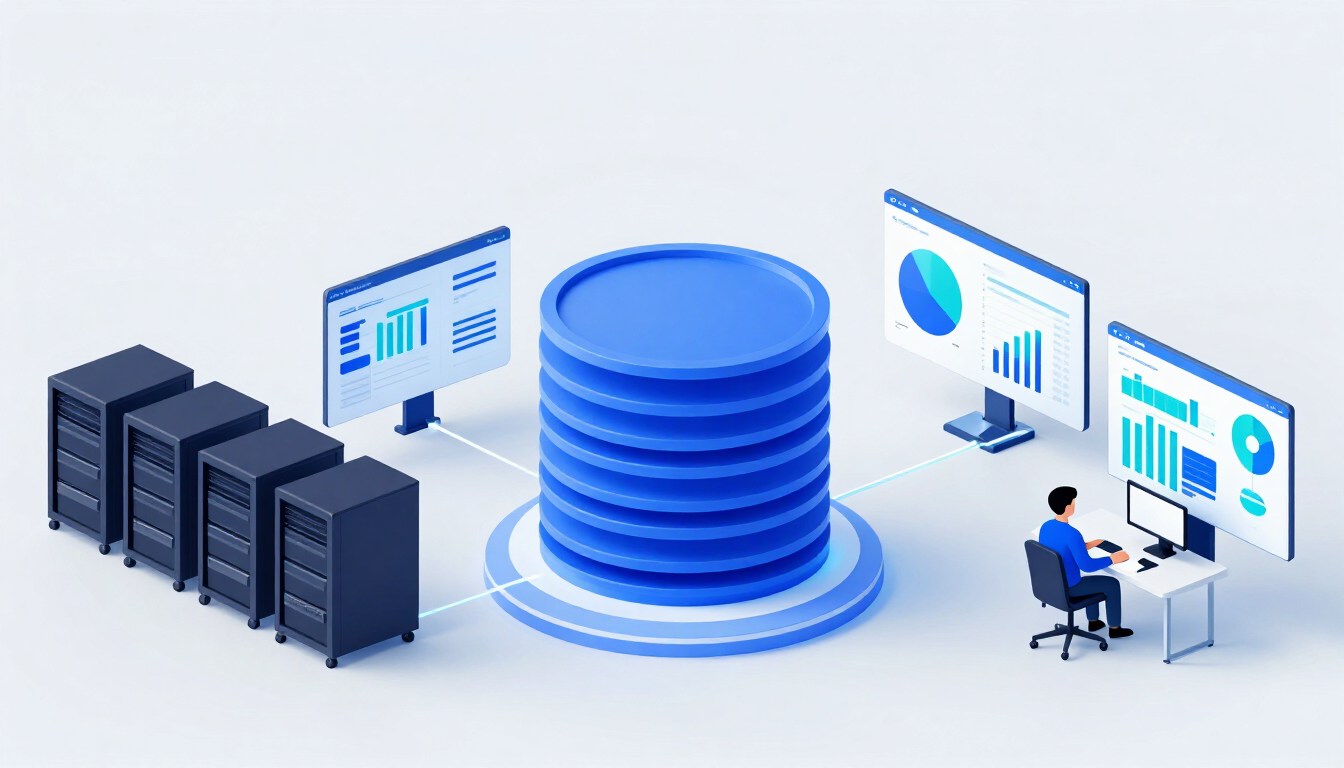
A Data Warehouse is a consolidated, organized repository for all of an organization’s key data sources. That could include an ERP, a CRM, an accounting software like QuickBooks, and really anything else whose data helps drive decision-making. But it’s not just a storage of raw data; a Data Warehouse has a Master Data Model that dictates how data is cleaned, organized, and combined between systems.
The Warehouse is typically hosted in the cloud using tools like Snowflake, SQL Servers, or a number of other software. The choice of specific software depends on the company’s existing infrastructure and technical capabilities, so it’s not a one-size-fits-all choice.
How does this change the reporting paradigm?
A Data Warehouse does three main things for reporting:
- It creates a single source of truth. When data is coming from multiple sources and multiple people are analyzing it, it’s very common for the data to become inconsistent or get analyzed in different ways. While some parties may say the ERP is the source of truth on finance, another may say it’s their accounting software. More often than not, this creates deviating insights on the company. Coupling in a Data Warehouse with a living data dictionary significantly reduces the risk of this happening.
- It ensures the data is clean and consistent. A well-managed Data Warehouse incorporates a cleaning process to the data, ensuring consistent format, removing oddities, and ensuring trust with the data. It’s even recommended that a dashboard or two is created to track the data quality of a Data Warehouse so that issues are proactively addressed and resolved.
- It simplifies the analytics development process. An analytics or BI development team is grabbing data from every data source in a company, which may require maintaining a number of data connections. Further, they’re combining datasets within each individual report or dashboard. This can create duplicative work and inconsistent merging of datasets, causing inconsistencies between reports. A Data Warehouse normalizes the aggregation of data and centralizes all data sources in a single location. This both simplifies the connection process and ensures that data is combined consistently throughout the organization.
What’s an example of a problem that a Data Warehouse solves?
Let’s consider a common questions executives have: what is the true profitability of a given customer?
When you think about it, the data to answer that question lies in multiple sources. The acquisition process was likely captured in the CRM along with the expected sales volume and dollars. The ERP then captured the actual purchases and what revenue was actually realized. That may include discounts, adjustments, and other financial adjustments. You then might ship the product to the customer; that data is going to be in a TMS system. Finally, you might even have a different tool for customer service to see if they needed service or additional service revenue was realized.
Without a Data Warehouse, you could only see one part of the picture. But with a Data Warehouse that has a consistent customer unique key, you can link each of these datasets together and analyze the entire picture of the customer.
You may find that some of your highest-revenue customers may not be the most profitable; they may look great on paper, but when you factor in their service costs and their return rate, they may be a bigger pain than you realize.
You may also find that your easiest sales closes are your biggest operational nightmares. The customers who buy low-cost items may be easy to close, but they could be the hardest to please.
What’s the difference between a Data Lake and a Data Warehouse?
You may have heard the term “Data Lake”, maybe even as an alternative to “Data Warehouse”. These two tools are similar, but have distinct differences that dictate their value.
A Data Warehouse seeks to be the back end of reporting and analytics. Its value is in not only a storage of raw data, but also in its organization and strategy. The idea is that the data is ready to go into a data visualization tool, Excel, or anything else. It may be in its raw form, but more likely than not, it’s been cleaned, transformed, and merged with other raw datasets. The typical end user for a Data Warehouse is an analyst/BI developer or management.
A Data Lake serves a slightly different purpose. A Data Lake is designed to be a pure repository of data, storing data in its raw form in large volumes. That means that it’s also great for unstructured data and variable data types, like .pdfs, logs, and other abnormal data types. It may be ready for analytics and visualization, but not always. Typically, the end users of a Data Lake would be data engineers.
Generally, organizations making the jump from just one-system reporting would be best served creating a Data Warehouse over a Data Lake. But long-term, a Data Lake also provides some great benefits to organizations who produce a lot of data.
How would my organization get started?
Building a Data Warehouse can be a challenging and complex but highly valuable effort. Some organizations with internal data talent may be able to develop on their own. A large part of the work is in creating and maintaining ELT/ETL processes to transfer the data from the core systems into the Warehouse; if an organization has existing ELT/ETL processes and a solid tool, they may be able to handle the effort themselves.
If an organization doesn’t, it would be advisable to seek out Data Warehouse consulting services. As developing a Data Warehouse is commonly a one-time project, it’s very common to outsource the creation to a third party that does it for a living and to avoid hiring immediately. The upfront cost may be higher that way, but it ensures that the project is successful in driving value-add to the business decision-making process, which is the ultimate goal.
At the end of the build, the company can then elect to either hire internally to manage the created Warehouse or elect to use the same or a different consulting group to manage the Warehouse on a fractional basis. The decision typically revolves around the level of maintenance. If there is at least a full 40 hours per week of work, it’s better to hire internally; if not, a fractional data manager from a consulting firm may be more cost-effective.
Note – the same process and logic can be said for Data Lakes. Data Lake consulting (or Data Lake consulting services) provides the short-term expertise that organizations need without requiring immediate long-term investment in new employees.
Can Brewster Consulting help?
If your organization has outgrown ERP-only reporting, disconnected systems, or manually combining data in Excel, building a Data Warehouse may be the next step.
Brewster Consulting Group designs and builds Data Warehouses across a range of industries, technology environments, and levels of complexity. Our team works with platforms including SQL Server, Snowflake, Azure, dbt, and many more depending on the needs of the organization.
If you're not sure whether you actually need a Data Warehouse yet, that's a good place to start. We can help you evaluate your current reporting environment, identify where the limitations are coming from, and determine whether a Data Warehouse makes sense for your business. Schedule a time on our calendar to talk with our team about your current reporting environment and what a Data Warehouse could look like for your organization.

At Brewster Consulting Group, we recognize that managing data can be a daunting task for small and mid-sized enterprises. Allow us to assist you in harnessing the potential of operational intelligence! Reach out to one of our specialists today to refine your data strategy, optimize your processes, and establish solid governance. Ready to cultivate data analysis and propel scalable growth? Your journey begins right here!