How to Modernize Your Company’s Data
As a company matures over time, it can feel that its data has not matured with it. While new capabilities, systems, and technologies are being implemented, the company’s data is still stuck in the past. It might be unused, inaccurate, difficult to access, or confined to a single system, all of which limit how effectively it can support business decision-making. Data warehouse modernization helps solve this problem by creating a more structured, connected, and reliable data environment.
What Does a Modernized Data Environment Look Like?
At its core, a modernized data environment enables employees to use data to drive better decision making and operations. While there may be some exceptions, as at its core, data is only as valuable as its ability to drive decision making.
To be able to leverage data in this way, you need it to have a few key attributes:
- The data has to be present and full: data that doesn’t exist or doesn’t have a way to be translated across systems or databases can’t be effectively analyzed or visualized.
- The data has to be accurate: inaccurate data creates inaccurate reporting and analytics, which in turn creates inaccurate decisions being made.
- The data has to be timely and consistent: the data must be ready to be used and available at a cadence consistent with the business need.
Without proper data management, most data systems will fail on at least one of these points. As such, it’s critical for a company to modernize its data to meet these needs to get the most out of their data.
Enter the Data Warehouse
One of the consistently best ways to modernize and mature a company’s data systems is to incorporate structure and consistency with a Data Warehouse.
A Data Warehouse is a structured repository of a company’s data with a clear organization method tailored to the business’s unique needs. It uses a number of data movements, called ETL or ELT pipelines, to move data from the company’s core systems – such as an ERP, a CRM, a Project Management tool, an HRIS, or others – into one location owned by the company.
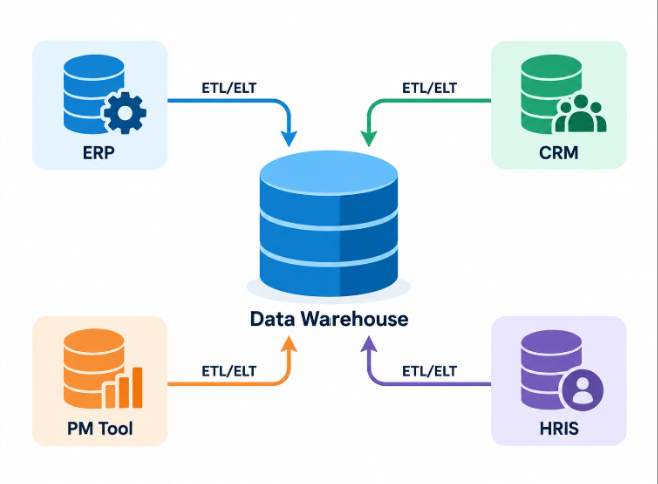
A Data Warehouse modernizes a company’s data so that it can be used more effectively to drive value. Specifically, a Data Warehouse:
- Ensures present and full data from core systems, as all of a company’s core data systems are present in the Warehouse and is organized with a company-specific data model.
- 2. Ensure accuracy of data within the Warehouse, as it leverages data quality management and quality reporting throughout its lifecycle.
- Ensures timely, consistent data, as the data now lies in one place instead of in numerous locations on a consistent, repeatable basis.
A Quick Note on Data Lakes
You may have heard of Data Lakes, which are similar to Data Warehouses, but have a few key differences, all of which tend to cause companies to favor Data Warehouses over Data Lakes for their Data Modernization efforts:
- A Data Warehouse seeks to create a data environment that facilitates reporting, analytics, and direct business value. A Data Lake seeks to create a clean repository of raw data from systems, which can help in the reporting and analytics process, but not as much as a Data Warehouse.
- A Data Warehouse is geared towards tabularized datasets that you would see in an Excel spreadsheet. A Data Lake can have this data type, but is specifically capable of handling file formats that are atypical, such as images and documents.
- A Data Warehouse has a defined structure and organization, lending it well to both reporting & analytics as well as AI integrations and automations. Data Lakes can be used for those, but they are much less structured and ready-to-go compared to Data Warehouses.
Build a Data Warehouse
All this is well and good, but how does one actually go about building a Data Warehouse? Like most difficult tasks, you need to start in the future to guide your present. You need to first define your goal – what are you trying to accomplish operationally? Is it to have reporting that speaks to the entire business ready at a moment’s notice for your team? Is it to ensure regulatory compliance with data or reporting?
From there, you work your way back. If you need to incorporate reporting that looks at a customer’s journey with your company, you’ll need to likely combine your ERP and your CRM to find that journey. If you want to ensure regulatory compliance by generating a report regularly, you’ll need to find the attributes of that report in your core systems and be sure to include and combine those in your Warehouse. This will create your Data Warehouse’s Data Model.
Finally, you need to execute that Data Model. That includes selecting technologies, establishing the Warehouse itself in your chosen tool, creating ETL/ELT pipelines to bring data from your systems to the Warehouse on the required frequency, and the combination of your data in the Warehouse as per your Data Model.
When Should a Company Modernize Its Data Warehouse or Data Environment?
There is not a single point at which every company needs to modernize its data environment, but there are common warning signs. Organizations often begin considering data warehouse modernization when reporting requires frequent manual exports, important data lives across disconnected systems, teams disagree on KPI definitions, reports take too long to produce, or existing infrastructure cannot support new analytics and AI initiatives.
If these issues are becoming more common as the business grows, it may be a sign that the company has outgrown its current data environment.
Need help?
Modernizing your company’s data with a Data Warehouse is not a small task. It requires a sound strategy with expert execution and a constant focus on the business value.
If you’re not sure where to get started, it’s best to seek out a professional to help guide you through a Data Warehouse Build. Seeking out Data Warehouse modernization services can help you avoid pitfalls and challenges that you didn’t know were there.
Brewster Consulting Group can help you if you’re wanting to learn more or get started building a data warehouse. We’ve built data warehouses for a number of industries with varying complexities and under varying budgets.
Even if you just want to learn more, feel free to schedule a conversation with our team of experts. We can help you understand what a data warehouse would look like and how it could benefit your unique organization.

At Brewster Consulting Group, we recognize that managing data can be a daunting task for small and mid-sized enterprises. Allow us to assist you in harnessing the potential of operational intelligence! Reach out to one of our specialists today to refine your data strategy, optimize your processes, and establish solid governance. Ready to cultivate data analysis and propel scalable growth? Your journey begins right here!