Best AI Knowledge Base Software (2026): 10 Tools to Build Your Company's Second Brain
A practical guide to choosing an AI intranet, AI-powered knowledge base, or "enterprise brain" for your company — including honest tradeoffs, pricing context, and which tool fits which company stage.
TL;DR — The quick-take comparison
| Rank | Tool | Best for | Stand-out feature | Starting price |
|---|---|---|---|---|
| 1 | Lore | SMB to mid-market companies that need a real company brain — fast ingestion, in-platform chat with shared context, reusable skills, scheduled agents, training that updates with the source, and MCP access from Claude, ChatGPT, and Cursor | Drop-in document ingestion, in-platform AI chat grounded in your full company context, reusable skills, scheduled agents, dynamically updated training, plus a native MCP server | Free / $350 per month |
| 2 | Glean | Enterprises 500+ already drowning in tools | Federated search across 100+ connectors | ~$40 per user/month |
| 3 | Guru | Customer-facing teams (CX, sales, support) | Verified-card model with expert ownership | $15 per user/month |
| 4 | Notion AI | Teams already deep in Notion | AI baked into the workspace you already use | $10 per user/month + Notion |
| 5 | Sana Labs | HR / L&D-heavy organizations | Strong learning + knowledge convergence | ~$30 per user/month |
| 6 | Mem AI | Solo operators & small teams as a personal second brain | Conversational, low-setup | $20 per user/month |
| 7 | Tettra | Slack-native small teams | Lightweight Q&A inside Slack | $4 per user/month |
| 8 | Bloomfire | Compliance-heavy mid-market | Audit-ready content controls | Custom |
| 9 | Slab | Engineering-heavy teams | Clean wiki + AI + version history | $8 per user/month |
| 10 | Atlassian Intelligence (Confluence) | Companies already on Confluence | AI bolted onto incumbent infrastructure | $11 per user/month + Confluence |
Prices reflect publicly listed entry tiers as of June 2026. Enterprise contracts vary substantially.
What is an AI knowledge base?
An AI knowledge base is a software layer that ingests your company's documents, conversations, and structured data, then lets your team query that knowledge in natural language and get cited, permission-aware answers. The category overlaps with three adjacent terms:
- AI intranet — the same idea, framed as the modern replacement for SharePoint, Confluence, or Google Sites
- Enterprise brain (or company brain, second brain) — the metaphor that captures why it matters: an organization-wide memory that any authorized employee can query
- RAG for enterprise — the underlying technique: Retrieval-Augmented Generation, where an AI model is grounded in your company's documents before it answers
All four phrases describe the same product category. The differentiation is positioning. Glean leans on "enterprise search." Guru leans on "knowledge management." Lore and Sana lean on "enterprise brain." Notion leans on "all-in-one workspace." Under the hood, they're solving the same problem: your company knows things, your employees can't find them, and ChatGPT can't help because your company isn't on the internet.
Why this category exists in 2026
Three things converged:
- AI assistants became useful — but they don't know your customers, your contracts, your protocols, or your last three board meetings. ChatGPT writes a generic email. Your business runs on specific ones.
- SharePoint and Confluence aged badly — they were built for "store and find," not "ask and answer." Folder navigation is a 1998 paradigm.
- MCP and similar protocols arrived — for the first time, AI tools can plug into company knowledge layers in a standardized way, instead of every vendor building bespoke integrations.
The result: a real market is forming for what 2020 would have called "an internal wiki" but 2026 calls "your company's second brain."
How we evaluated these tools
Every tool on this list was evaluated against five criteria:
- Retrieval quality — does it actually find the right answer, with citations?
- Permission model — can it respect "who can see what" inside the company?
- Integration breadth — how many systems can it pull from (Slack, Drive, Notion, GitHub, Salesforce, etc.) and how many AI clients can it plug into (Claude, ChatGPT, Cursor, Copilot)?
- Time to value — how long from signing the order form to "useful for the team"?
- Pricing transparency — can a buyer get a number without a 4-week procurement loop?
No tool aces all five. The ranking reflects which trade-offs make sense for which company stage.
1. Lore — best AI knowledge base for companies that want MCP-native AI
Best for: SMB to mid-market companies that want a real enterprise brain and want their team to query it from inside Claude Desktop, ChatGPT, Cursor, or any MCP-compatible client.
What it does: Lore ingests your documents (PDF, DOCX, PPTX, spreadsheets, markdown, plain text), auto-generates a structured wiki, and makes that wiki queryable through:
- A chat interface with citations (BYO key for Anthropic, OpenAI, Grok, Gemini, or Perplexity)
- A standalone MCP server, so your team can ask Lore questions from inside Claude Desktop or ChatGPT
- Scheduled "Enterprise Agents" that run repeatedly (e.g., "every Monday summarize last week's sales notes")
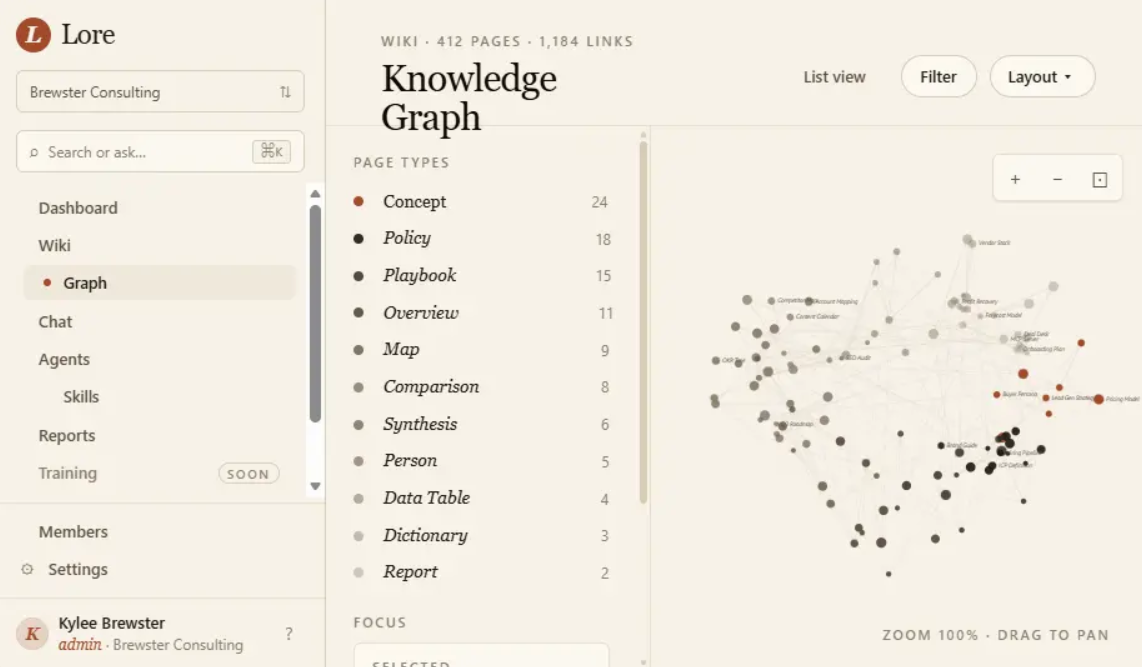
- Knowledge-graph visualization showing how pages connect
Stand-out features:
- Native MCP server — the only tool on this list that ships a Claude-Desktop-ready connector out of the box. Your employees can ask Lore questions from inside the AI tool they already use.
- Bring-your-own LLM keys — the AI bills go to your Anthropic/OpenAI account, not a per-seat markup. For a 50-person company this is typically a 60-80% cost reduction versus seat-priced competitors.
- Permission-aware retrieval — every search and chat result is filtered against the user's actual page-level grants before scoring. No "the model saw something it shouldn't have" leaks.
- AES-256-GCM API key vault with versioned keys and zero-downtime rotation.
Pricing (as of mid-2026):
- Free — 5 seats, 50 pages, 7-day audit log retention. Good for personal evaluation.
- Pro — $350 per month (5 seats included) or $3,500 per year (2 months free). $30 per additional seat per month. 5,000 pages, 5 active agents, 1,000 agent runs per month, 30-day audit log retention. 14-day free trial, no card required.
- Business — $750 per month (10 seats included) or $7,500 per year (2 months free). $40 per additional seat per month. 50,000 pages, unlimited active agents, 10,000 agent runs per month, 1-year audit log retention. 14-day free trial with card on file.
- Enterprise — custom pricing. Includes SSO (Azure AD, Okta, Google Workspace), HIPAA BAA, 99.9% SLA, dedicated success manager, custom audit log retention.
Best as a: Glean alternative for companies under 500 people who don't want enterprise contracts, a Notion AI alternative for teams that don't want to live in Notion, and the cleanest answer for any team that wants "ChatGPT, but it actually knows our company."
2. Glean — best AI intranet for large enterprises
Best for: Companies of 500+ employees with 50+ SaaS tools that need federated search across everything.
What it does: Glean indexes your company's content across 100+ connectors (Google Workspace, Slack, Notion, Confluence, Jira, Salesforce, Zendesk, GitHub, etc.) and lets employees search/chat across all of it from one bar.
Strengths: Best-in-class connector breadth. Strong enterprise security posture (SOC 2 Type II, SAML SSO, etc.). The most refined product in the category.
Weaknesses: Pricing typically lands at $40+ per user per month with annual minimums in the six figures. Procurement cycles are 3-6 months. Real overkill below ~300 employees. Limited customization for vertical workflows.
Best as: an enterprise-search system of record, not a wiki replacement. If you have a fast-growing 200-person company, you'll wait two years before Glean makes sense.
3. Guru — best knowledge base for customer-facing teams
Best for: Sales, customer success, and support teams that need fast access to verified answers.
What it does: Guru organizes knowledge as "cards" owned by subject-matter experts. Cards have verification cycles — the owner has to confirm accuracy every N days, or the card gets flagged.
Strengths: The verification model is genuinely useful. Strong Slack and browser-extension integrations. Decent AI search added on top of the older card-based UX.
Weaknesses: The card model adds overhead for teams that just want a wiki. AI features feel layered onto an older product. Pricing escalates fast above the $15 base.
Best as: a Guru alternative for teams whose primary need is in-context answers during customer conversations (Lore #1, Glean #2 if budget allows). A pure Guru-alternative shopping comparison should also include Bloomfire (#8).
4. Notion AI — best AI knowledge base if you already live in Notion
Best for: Teams whose entire workspace is already in Notion and want AI sprinkled on top.
What it does: Notion's AI add-on lets you query across your Notion workspace, draft content, and summarize pages. The Q&A feature is the closest analog to a dedicated knowledge base.
Strengths: Zero migration cost if you're already on Notion. Strong writing surface. AI summaries are useful.
Weaknesses: Limited retrieval quality compared to purpose-built tools. No real permission-aware Q&A across connectors outside Notion. Doesn't expose an MCP server. Slow to add agent-style automations.
Best as: a Notion AI alternative consideration set should include Lore (#1), Slab (#9 — cleaner editor), and Mem (#6 — better personal use). Notion is a workspace; the tools on this list are answer engines.
5. Sana Labs — best for HR and L&D-heavy companies
Best for: Organizations where training, learning, and onboarding consume meaningful operational time.
What it does: Sana combines a learning management system with an enterprise AI assistant. Employees can take structured training, ask Sana questions about company knowledge, and get personalized learning paths.
Strengths: Strong learning + knowledge convergence story. Good for compliance-driven training. Clean UI.
Weaknesses: Pricing is enterprise-only. Less compelling if you don't have heavy L&D needs. Smaller integration footprint than Glean.
Best as: an enterprise brain for companies whose primary knowledge-management problem is training-shaped.
6. Mem AI — best personal second brain that scales to small teams
Best for: Solo operators, executives, and teams under ~15 people who want a Notion-replacement that's AI-first.
What it does: Mem captures notes, ingests documents, and lets you query them conversationally. The mental model is "your second brain," not "your company intranet."
Strengths: Lowest setup cost. Excellent for individuals. Strong mobile capture.
Weaknesses: Doesn't scale to permission-aware multi-tenant deployments. No MCP server. Limited as a true company-wide knowledge layer.
Best as: a personal AI second brain or for tiny teams that don't have permission complexity. Stop using it at headcount 20.
7. Tettra — best lightweight wiki for Slack-native teams
Best for: 20-100 person teams whose primary communication channel is Slack.
What it does: Tettra is a wiki with a strong Slack bot. Ask a question in Slack, get an answer from the wiki. Simple Q&A workflow.
Strengths: Cheapest entry point on the list ($4 per user). Slack integration is genuinely good. Easy to deploy.
Weaknesses: Limited retrieval beyond Slack-shaped Q&A. No MCP. Won't scale into a full enterprise brain.
Best as: the cheapest Glean alternative that does something useful for Slack-heavy teams. Outgrow it at ~150 employees.
8. Bloomfire — best for compliance-heavy mid-market
Best for: Mid-market companies with audit, compliance, or regulatory requirements (healthcare, financial services, regulated manufacturing).
What it does: Bloomfire focuses on enterprise content controls — versioning, audit trails, content expiration, restricted-access flows. AI search is layered on.
Strengths: Real compliance posture. SOC 2 Type II, content lifecycle management, structured workflows for content review.
Weaknesses: Heavier setup than newer tools. UX feels enterprise-2018. AI features are catching up but not leading.
Best as: the Bloomfire alternative shopping list should also include Lore (#1, which can be configured to similar compliance posture with custom implementation) and Glean (#2 — with an enterprise contract).
9. Slab — best for engineering-heavy teams
Best for: Engineering and technical teams that want a clean wiki + AI on top.
What it does: Slab is a modern wiki with strong markdown support, version history, and AI summarization.
Strengths: Best-in-class editor for technical content. Strong GitHub integration. Clean version control.
Weaknesses: Limited retrieval beyond the wiki itself. No MCP. AI features are useful but not a complete knowledge layer.
Best as: a Notion AI alternative for technical teams that value a real wiki over a database-block UX.
10. Atlassian Intelligence (Confluence + AI)
Best for: Companies that already pay Atlassian's invoice and aren't going anywhere.
What it does: Atlassian's AI features layered onto Confluence and Jira. Summarization, page generation, Q&A across Atlassian content.
Strengths: If you already have Confluence, the marginal cost is low. Improves an incumbent system.
Weaknesses: Bound by Confluence's architecture. Limited retrieval quality compared to purpose-built tools. Don't choose this; tolerate it if it's already your environment.
Best as: an answer to "we already have Confluence and don't want to leave." If you're starting fresh, every other tool on this list is a better choice.
How to choose: a decision framework
| Company stage | Recommended starting point |
|---|---|
| 1-15 people, solo / founder-led | Mem(#6) or Notion AI(#4) |
| 15-50 people, growth mode | Lore(#1) or Tettra(#7) for Slack-native teams |
| 50-300 people, professional ops | Lore(#1) or Slab(#9) for engineering-heavy |
| 300-1000 people, mid-market | Lore(#1), Guru(#3) for CX-heavy, Bloomfire(#8) for compliance-heavy |
| 1000+ employees, true enterprise | Glean(#2) or Sana(#5) if L&D-heavy |
Frequently asked questions
What is the difference between an AI knowledge base and an AI intranet?
There is no meaningful difference. "AI intranet" is the marketing frame for "we're replacing SharePoint." "AI knowledge base" is the frame for "we're a smarter wiki." "Enterprise brain" or "company brain" is the frame for "we make your company queryable." All three describe the same product category in 2026.
What is RAG for enterprise?
RAG stands for Retrieval-Augmented Generation. It's the technique most AI knowledge bases use: when you ask a question, the system retrieves relevant chunks of your company's documents, then asks an LLM to generate an answer grounded in those chunks. Every tool on this list uses RAG. The quality differences come from how well each retrieves (hybrid search vs. vector-only, permission filtering, ranking) and how strict each is about citing sources.
What is a "second brain" for a company?
A second brain is the metaphor that originated in personal knowledge management (Tiago Forte's framing). Applied to a company, it means: an external, queryable store of everything the company collectively knows — protocols, decisions, customer history, technical knowledge, cultural memory — that any authorized employee can search and learn from. The tools on this list are the software layer that makes a company-wide second brain practical.
Is there a free AI knowledge base?
Lore offers a free tier with 5 seats and 50 pages, which is suitable for small-team evaluation. Mem, Notion AI, and Tettra also have free or near-free entry tiers. None of these scale to a real company-wide deployment without paying. The honest answer: budget at minimum $10-30 per user per month for a tool that actually works, plus implementation time. Free tools optimize for personal use, not company memory.
Which AI knowledge base supports Claude Desktop or ChatGPT directly?
As of June 2026, Lore is the only tool on this list that ships a native MCP server, which means your team can connect Lore to Claude Desktop, ChatGPT, Cursor, or any MCP-compatible client and query the company brain from inside those AI tools. Other tools require custom integration work to achieve this.
What is the best Glean alternative for SMB?
For companies under 300 employees, Lore is the best Glean alternative — Glean is overkill at that scale and the procurement cycle is months long. Guru is a reasonable alternative for customer-facing teams specifically. Bloomfire works for compliance-heavy mid-market.
What is the best Guru alternative?
Lore, Glean, and Bloomfire are the strongest Guru alternatives, depending on team size. Lore for SMB and mid-market. Glean for 500+ enterprises. Bloomfire for compliance-heavy teams.
What is the best Notion AI alternative?
If your reason for leaving Notion AI is "the retrieval isn't good enough," Lore is the answer. If your reason is "we want a cleaner writing surface," Slab is the answer. If your reason is "we want better personal use," Mem is the answer.
How much should a company budget for an AI knowledge base?
For a 50-person company in 2026, expect $10-40 per user per month for software, plus $25-75k for implementation if you want it set up properly (taxonomy, ingestion, agent configuration, training). Lore's Pro tier starts at $350 per month with 5 seats included; Business at $750 per month with 10 seats included — both materially cheaper than per-seat competitors at the same scale. The implementation cost is usually higher-leverage than the software cost — most knowledge base failures come from bad ingestion, not bad software.
Is an AI knowledge base secure?
Depends entirely on the vendor. Look for: SOC 2 Type II certification, SAML SSO, permission-aware retrieval (the AI cannot return content the user can't see), encrypted-at-rest storage with rotatable keys, audit logging of every query and document access, and BYO LLM keys if you want your queries to go to your own Anthropic/OpenAI account instead of the vendor's. Glean meets all of these. Many smaller tools meet a subset.
What is the difference between an AI knowledge base and ChatGPT Enterprise?
ChatGPT Enterprise is a general-purpose AI assistant with strong data controls and (limited) document connectors. It does not have a structured knowledge model, doesn't do permission-aware retrieval at the page level, and doesn't ship workflows like scheduled agents or knowledge graphs. An AI knowledge base is the layer ChatGPT Enterprise needs to actually be useful for company-specific questions. Many companies run both: ChatGPT Enterprise as the AI assistant, and a knowledge base like Lore as the source of truth the assistant queries via MCP.

At Brewster Consulting Group, we recognize that managing data can be a daunting task for small and mid-sized enterprises. Allow us to assist you in harnessing the potential of operational intelligence! Reach out to one of our specialists today to refine your data strategy, optimize your processes, and establish solid governance. Ready to cultivate data analysis and propel scalable growth? Your journey begins right here!