
Your Google Reviews Are a Lead Generation Channel. Are You Treating Them Like One?
Kade Brewster • April 6, 2026
Your Google Reviews Are a Lead Generation Channel. Are You Treating Them Like One?
Most business owners think about Google reviews as a reputation problem. Something to monitor, react to when they go sideways, and mostly ignore when things are going fine. That framing leaves a significant amount of money on the table.
Google reviews are not just a trust signal. They are an active lead generation channel. One that directly affects your search visibility, your conversion rate, and your ability to win back customers who had a bad experience. And most businesses are managing them in a way that costs them on all three fronts.
The Numbers Worth Understanding
88% of consumers trust online reviews as much as a personal recommendation. That statistic reframes the conversation entirely. When a prospect who has never heard of your business finds you through search, the reviews they read carry the same weight as a friend’s recommendation. That’s not soft brand sentiment. That’s a direct input into whether they call you or your competitor.
53% of customers who leave a review expect a response within seven business days. Half of your reviewers, positive and negative, are actively waiting to hear back from you.
1 in 3 businesses never responds to reviews at all. Which means if you do respond consistently, you are already ahead of a third of your market without doing anything else.
And the compounding effect: businesses that respond to 100% of their reviews receive 35% more engagement on their Google profile over time. That’s more clicks, more calls, more conversions, driven entirely by whether you show up and respond.
What Silence Actually Costs You
When a customer leaves a negative review and gets no response, they don’t move on with a neutral impression. They draw a conclusion. That the business doesn’t care, or didn’t see it, or saw it and chose to ignore it. Any of those conclusions is bad. And that conclusion is visible to every future customer who reads it.
You had one window to reshape that narrative. Not responding closes it permanently.
On the search side, Google’s algorithm treats response rate and response speed as ranking signals. A business that consistently responds quickly to reviews is signaling engagement to Google. And getting rewarded with higher placement in local search results. A business that rarely responds is signaling the opposite.
The math here is not complicated. More reviews responded to, faster, means higher local rankings, means more people finding you, means more leads. Not responding is not neutral. It has a measurable negative effect on your visibility.
Why Most Businesses Don’t Fix This
It’s not that owners don’t understand reviews matter. It’s that responding consistently is genuinely time-consuming when done manually.
Reading each review, diagnosing the tone, crafting a response that sounds like your business and not a template, escalating the difficult ones for human attention, that process takes five to twenty minutes per review depending on complexity. Multiply that by your review volume across locations and it becomes a job in itself.
So, most businesses either delegate it inconsistently, respond to some but not others, or let it fall off entirely during busy periods. The result is a response rate well below 100% and response times well beyond the seven days customers expect.
What AI-Powered Review Management Actually Looks Like
A well-built AI workflow changes this completely. Here’s the basic structure:
- A new review posts to your Google My Business profile and triggers the system in real time.
- The AI reads the review, classifies sentiment as positive, neutral, or negative, and checks for risk signals like legal language, safety complaints, service failure keywords.
- Low-risk reviews get a drafted response in your brand voice and are posted automatically.
- High-risk reviews route to a human via Slack, email, or SMS for review before anything goes out.
The result: 100% response rate, response times under an hour for most reviews, and responses that actually sound like your business because you trained the system on your brand voice.
This is not a concept. It’s a buildable workflow using tools that exist right now. Tools like N8N, the Google My Business API, and an LLM like Claude. We’ve built an app that is a working version of this that hooks directly into a Google My Business profile and handles the full workflow from detection to response to escalation. You can learn more about that here.
Is This Right for Every Business?
This workflow delivers the most value for businesses that get meaningful review volume and for whom local search visibility directly drives revenue. Multi-location service businesses, healthcare practices, home services companies, and retail operations are the clearest fits.
If you get ten reviews a month and your team has bandwidth to respond manually, the ROI calculus is different. But if reviews are piling up, response rates are inconsistent, or you’re managing multiple locations, this is worth a serious look.
What to Do Next
If you want to build this yourself, the core components are N8N, the Google My Business API, and a Claude or OpenAI API key. The workflow is straightforward to build for someone comfortable with automation tools.
If you want it built and running without investing your own time in the build, we set this up for businesses directly with our app. The setup is a one-time engagement, with a small monthly licensing fee afterward. The system runs without ongoing management on your end; your team only touches the escalations that actually need human judgment.
Either way, the underlying problem is the same: if you’re not responding to reviews consistently and quickly, you’re leaving local search ranking, customer retention, and new lead conversion on the table. The fix is available and it’s not complicated to implement.
If you want to talk through whether this is the right fit for your business, book a 30-minute call at brewsterconsulting.io. We’ll walk through your current review volume and response rate and tell you exactly what a setup like this would look like for your specific situation.

At Brewster Consulting Group, we recognize that managing data can be a daunting task for small and mid-sized enterprises. Allow us to assist you in harnessing the potential of operational intelligence! Reach out to one of our specialists today to refine your data strategy, optimize your processes, and establish solid governance. Ready to cultivate data analysis and propel scalable growth? Your journey begins right here!
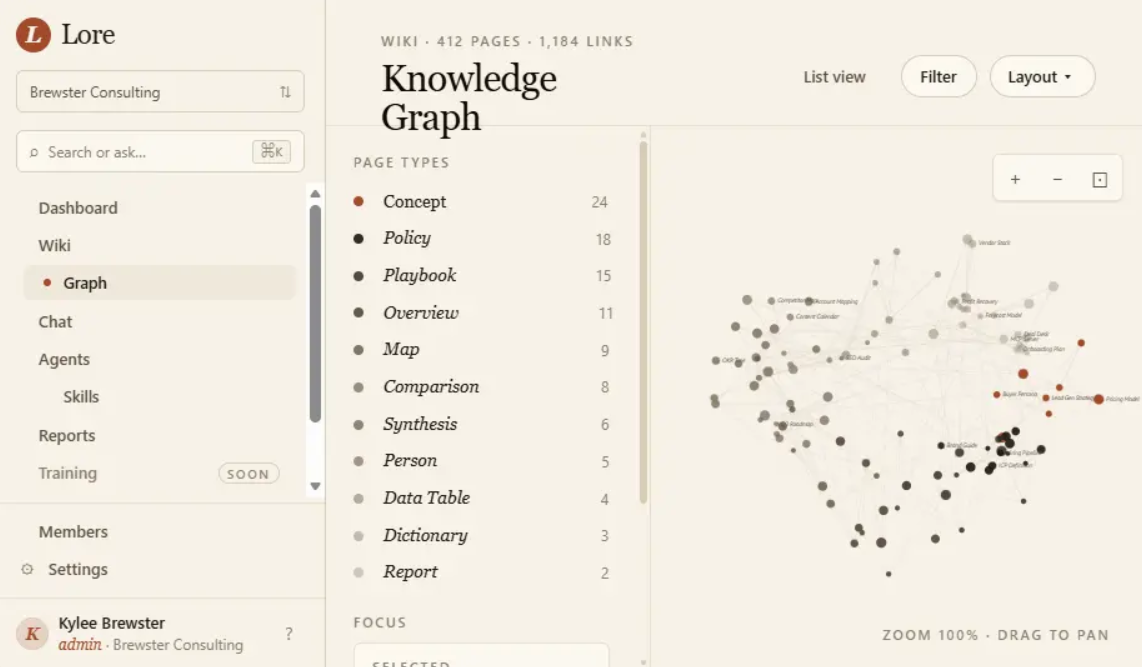
The 10 best AI knowledge bases & AI intranets for 2026, ranked by company stage. Compare Lore, Glean, Guru, Notion AI, and more — with real pricing.

For decades, organizations were designed around a simple reality: information was scarce, expertise concentrated, and decisions needed to move through a structured chain of command. The traditional Org Chart wasn’t just about hierarchy; it was about control. Decisions flowed upward for approval, then back down for execution. While often criticized for being slow or bureaucratic, this model provided something incredibly valuable: clarity. Everyone knew who was responsible. That clarity is now disappearing. Historically, this “ladder effect” ensures that decisions, especially those with meaningful business impact, were vetted, aligned, and ultimately owned. Leaders at the top had the context, the authority, and the accountability. And while employees at lower levels often felt disconnected from decision-making, the structure itself protected the organization. It created consistency, reinforced strategic alignment, and maintained credibility with stakeholders. But over the past several years, even before AI entered the picture, organizations began pushing for change. Employees wanted more autonomy. Businesses wanted a faster decision cycle. Leaders started experimenting with flatter structures, cross-functional teams, and decentralized execution. The goal was clear: reduce friction and move faster. Then AI arrived and accelerated everything. Today, employees across all levels of an organization can access insights, generate recommendations, analyze trends, and make decisions in ways that were previously reserved for senior leadership. A frontline employee can now use AI to evaluate customer behavior, recommend pricing adjustments, forecast outcomes, or optimize workflows in real time. What used to require layers of analysis and approval can now happen in minutes. AI has effectively distributed decision support capability across the organization, allowing individuals to act in was that previously required managerial or executive oversight. As noted in this Wall Street Journal article , this shift is already reducing reliance on middle management and enabling more autonomy at the individual contributor level, signaling a broader move toward flatter and more flexible org structures. Decision-making has moved down the org chart. But control has not moved with it. And that is where the real problem begins. On the surface, this looks like progress. And in many ways, it is. Organizations are moving faster, employees are more empowered, and decision-making is becoming more responsive to real-time conditions. But beneath that progress is a growing issue that many businesses have not fully addressed. While decision-making capability has moved down the org chart, governance and control have not evolved at the same pace. The systems that once ensured accountability, clear approval chains, defined ownership, and structured oversight, have not been redesigned for a world where decisions can be made anywhere in the organization. According to California Management Review, traditional accountability frameworks begin to break down in AI-driven environments because it becomes difficult to determine where responsibility truly lies when outcomes are influenced by algorithmic recommendations. Organizations are left asking a fundamental question: who is actually accountable for the decision? At the same time, most organizations are not prepared to answer that question. Despite rapid adoption, governance maturity is lagging significantly behind AI usage. As highlighted in this ITPro article , while the vast majority of organizations are already leveraging AI, only about 7% have fully embedded AI governance frameworks in place, and just 4% feel prepared to support AI at scale . This gap between adoption and governance has been described as a “ticking time bomb,” as organizations continue to expand AI usage without the corresponding controls needed to manage risk and accountability. This is where the real tension exists. Organizations have successfully distributed decision-making capability, but they have not distributed accountability with it. This creates an environment where decisions are made faster, but responsibility becomes increasingly ambiguous. And this is not just a process issue; it is an organizational design issue. AI is not simply changing workflows; it is fundamentally changing authority. It is redefining who has the ability to influence outcomes and how decisions are made across the business. That shift can absolutely be a positive one. For years, organizations have struggled with overly rigid structures that slowed innovation and limited the contributions of employees closer to the work itself. AI has introduced a way to unlock that potential, allowing organizations to operate with more speed, flexibility, and responsiveness. But that only works if there are checks and balances in place. AI is not infallible. It does not inherently understand the strategic priorities of your organization, your risk tolerance, or the broader context behind critical decisions. It can generate recommendations that appear sound but are misaligned with business objectives, or that overlook key nuances that experienced leadership would recognize. Without proper governance, organizations risk empowering employees to make decisions that feel informed, but ultimately create misalignment, inconsistency, or even significant business risk. So where do organizations go from here? The answer is not to pull decision-making back up the org chart. That would eliminate many of the advantages AI brings. The answer is to evolve governance in a way that matches how decisions are now being made. Organizations need to move toward a model where execution is decentralized, but standards, accountability, and oversight remain clearly defined and consistently enforced. This includes implementing clearer ownership structures for AI-assisted decisions, establishing governance guardrails, and ensuring that decision-making authority is aligned with both capability and responsibility. What we are starting to see, and what will separate leading organizations from the rest, is a shift toward more intentional governance models that are built for this new reality. Instead of relying on legacy approval chains, organizations are beginning to define decision rights more explicitly, outlining where AI can be used, where human oversight is required, and how decisions should be escalated when risk thresholds are met. Some are introducing cross-functional governance structures to ensure AI usage is aligned across departments, while others are focusing on embedding accountability directly into workflows so that ownership is never ambiguous, even when AI is involved. From our perspective at Brewster Consulting Group, the organizations making the most progress are the ones that take a step back before scaling forward. They are not just asking, “Where can we use AI?” but rather, “Are we ready to use AI in a way that supports the business?” This is where structured approaches, like an AI maturity assessment , become critical. Understanding where an organization stands across governance, data readiness, process alignment, and accountability allows leadership teams to identify gaps before they become risks. It provides a clear path forward, ensuring that AI adoption is not just fast, but effective and sustainable. We often see organizations rush to implement AI tools without first defining the processes and governance structures that will support them. The result is fragmented usage, inconsistent decision-making, and growing confusion around ownership. The alternative, and the approach we recommend, is to build governance in parallel with adoption. That means strengthening data governance, so decisions are based on reliable information, refining processes so AI fits naturally into how work gets done and clearly defining roles and responsibilities so accountability scales alongside capability. Because ultimately, this is not just about technology. It is about control, alignment, and long-term success. The organizations that succeed in this next phase will not be the ones that adopt AI the fastest. They will be the ones that recognize what AI is truly changing, and take the steps to redesign their governance, their processes, and their operating models accordingly. Whether you are just beginning to explore AI adoption or are already scaling AI across departments, taking the time to evaluate your current structure, governance approach, and operational readiness can make the difference between sustainable transformation and fragmented execution. If you would like to discuss how your organization is currently approaching AI and where potential gaps may exist, we invite you to schedule a conversation with our team to explore what a more structured and scalable path forward could look like.

Artificial Intelligence has rapidly transitioned from a long-term innovation topic to an immediate strategic priority. In today’s environment, executive teams are no longer asking if they should adopt AI; they are being pressured to define how quickly they can implement it and where it will deliver measurable impact. Boardrooms are filled with discussion about automation, productivity gains, and competitive differentiation. Investors are evaluating AI maturity as a signal of future readiness. Competitors are announcing new capabilities at an accelerating pace. The pressure to act is no longer subtle; it is systemic. And in many ways, that pressure is justified. AI has the potential to fundamentally reshape how organizations operate. It can reduce the need for manual processes , enhance decision-making, improve customer responsiveness, and unlock entirely new business models. For executives responsible for growth, efficiency, and long-term viability, ignoring AI is not a viable option. However, amid this urgency, critical misalignment is emerging. Organizations are increasingly treating AI automation as a starting point rather than a scaling mechanism. In the rush to modernize, many are bypassing one of the most essential steps in any transformation effort: process improvement. This shift may appear subtle, but its implications are significant. Process improvement historically served as the foundation for operational excellence, ensuring that workflows are efficient, repeatable, and aligned with business objectives. It is the discipline that identifies inefficiencies, eliminates waste, and creates the structure necessary for sustainable performance. AI, by contrast, is an accelerator. It amplifies what already exists. When these roles are misunderstood or reversed, organizations risk building advanced capabilities on unstable ground. Instead of enabling transformation, AI initiatives begin to expose and often intensify existing weaknesses. What makes this particularly concerning is that many organizations are aware of these foundational gaps and are proceeding regardless. The desire to capture the perceived benefits of AI (speed, scale, efficiency, etc.) can overshadow the operational reality beneath the surface. The result is a growing pattern across industries: AI initiatives that stall, underperform, or fail entirely don’t necessarily do so due to a lack of technology capability, it is typically because the environment in which it is deployed is not prepared to support it. This is not an argument against AI. Quite the opposite. It is a call for a more disciplined and strategic approach to AI implementation . One that recognizes that the success of AI is not determined by the sophistication of the tools, but by the strength of the foundation they are built upon. The Rush to Automate – Without the Foundation AI promises speed, scale, and efficiency. For executives tasked with driving growth and innovation, that promise is compelling. Automation can reduce manual effort, improve responsiveness, and unlock new capabilities. However, what is increasingly evident across industries is that organizations are rushing toward automation without first addressing the underlying processes that automation is meant to enhance. That is not just anecdotal; it is systemic. According to the World Economic Forum , 55% of companies report that outdated systems and processes are their largest barrier to AI implementation, yet many of these same organizations continue to push forward with AI initiatives anyway ( World Economic Forum, “Why AI Fails Without Streamlined Processes” ). This statistic highlights a critical contradiction: Executives understand operational gaps exist in their organizations, but the urgency to adopt AI often overrides the discipline required to fix them first. Why AI Initiatives Fail Without Process Improvement The high failure rate of AI initiatives is not simply the result of immature technology or unrealistic expectations; it is often the result of insufficient preparation. Estimates suggest that as many as 80% of AI initiatives fail , particularly when factoring in technical, compliance, and adoption challenges, as highlighted in the same World Economic Forum discussion ( World Economic Forum, “Why AI Fails Without Streamlined Processes” ). While these failures are frequently framed as issues of implementation complexity, the underlying causes are far more fundamental. Research from WorkOS ( “Why Most Enterprise AI Projects Fail – and the Patterns That Actually Work”) identifies consistent failure patterns across enterprise AI implementations, most notably the absence of: A clearly defined operational framework Documented and standardized workflows Ownership and accountability across teams Reliable, high-quality data management practices Alignment between business objectives and technical execution When these elements are missing, the downstream impact is predictable. Teams struggle with unclear roles and responsibilities, leading to gaps in execution and stalled initiatives. Data becomes fragmented or inconsistent, limiting the effectiveness of AI models and eroding trust in outputs. At the same time, processes themselves are often incomplete, with missing steps or undocumented variations that introduce ambiguity into otherwise critical workflows. These are not isolated issues; they are common conditions in many organizations. The implication for executive leaders is clear: AI does not fail in isolation. It fails in environments that are not prepared to support it. Automation Doesn’t Fix Inefficiency, It Scales It One of the most persistent misconceptions surrounding AI is that it can serve as a corrective mechanism for operational inefficiencies. The reality is quite the opposite. AI is inherently dependent on the systems, processes, and data it is built upon. It does not independently diagnose and repair flawed workflows: it executes within them. When organizations automate without first improving their processes, several outcomes tend to emerge: Errors occur faster and more frequently because flawed logic is executed at scale. Operational complexity increases , as automation layers are added on top of already fragmented systems. Root causes become harder to identify , as issues are embedded within automated workflows. Costs rise over time, as organizations invest more resources into fixing problems that were never addressed at the source. In effect, automation acts as a multiplier . If the underlying process is efficient, AI amplifies that efficiency and likewise, if the process is broken, AI accelerates the breakdown. This is why organizations that skip process improvement often find themselves revisiting it later, at a significantly higher cost and with greater disruption. The Strategic Role of Process Improvement For executive leaders, process improvement should not be viewed as a prerequisite checkbox before AI adoption. It should be recognized as a strategic capability that directly enables the success of AI initiatives. Process improvement provides the structure, clarity, and discipline required for AI to deliver meaningful outcomes. At a deeper level, it contributes to several critical areas: Process Clarity and Standardization When workflows are clearly defined and standardized, AI systems can operate with consistency and predictability. This reduces variability and ensures that automation aligns with intended outcomes. Data Readiness and Quality High-quality data is foundational to any AI initiative. Process improvement ensures that data is captured, managed, and maintained in a way that supports accurate analysis and decision-making. Poor data quality can introduce risk at every stage, from model training to execution. Identification of High-Value Opportunities Through process analysis, organizations can identify bottlenecks, inefficiencies, and cost drivers. This insight allows executives to prioritize AI investment where they will deliver the greatest return and target high-impact use cases. Organizational Alignment and Accountability Clear processes define roles, responsibilities, and ownership. This alignment is essential for successful AI implementation, particularly in cross-functional environments. Without it, initiatives often stall due to confusion or lack of coordination. Measurable and Sustainable Outcomes Process improvement enables organizations to establish process definition and baseline performance metrics for their execution . This makes it possible to measure the impact of AI initiatives and ensure that improvements are sustained over time. In this sense, process improvement is not separate from AI strategy; it is integral to it. A More Disciplined Path to AI Adoption For organizations seeking to move forward with AI in a meaningful and sustainable way, a more structured approach is required. This approach prioritizes readiness over speed and alignment over experimentation. Step 1: Build Strategic Awareness Executives should begin by understanding the potential applications of AI within their organizations. This includes identifying areas where automation could enhance efficiency, improve customer experience, or reduce operational costs. However, this stage should remain exploratory, not reactive. Step 2: Establish Operational Readiness Before any technology is implemented, organizations must assess and improve their processes. This includes mapping workflows, identifying inefficiencies, addressing data quality issues, and standardizing operations. This step is often the most time-intensive, but also the most critical. Step 3: Align AI with Business Objectives With a solid operational foundation in place, organizations can begin to define how AI will integrate into their workflows. This involves selecting appropriate use cases, evaluating technology options, and ensuring alignment with strategic goals. At this stage, AI becomes a targeted solution, not a broad initiative. Step 4: Execute with Governance and Discipline Successful AI implementation requires more than technical deployment. It requires governance frameworks, data security protocols, change management strategies, and ongoing performance monitoring. Execution must be deliberate, structured, and aligned with long-term objectives. The Executive Imperative AI is often positioned as a competitive differentiator, and in many cases, it is. But its effectiveness is entirely dependent on the environment in which it is deployed. What we see across industries is not a failure of AI as a concept, but a failure of organizations to prepare for it properly. The tendency to prioritize speed over readiness is understandable. Market pressures are real, and the pace of technological change is accelerating. But for executive leaders, the responsibility is not to move fastest, it is to more correctly. That means: Recognizing that process improvement is not optional. Investing in operational and data readiness before automation. Aligning AI initiatives with clearly defined business outcomes. Building a foundation that can support long-term scalability. Because ultimately, AI will not transform a business on its own. Again, it will only enhance what already exists. And for organizations that take the time to build the right foundation, that enhancement can be transformative. For organizations serious about realizing the full value of AI, operational readiness cannot be overlooked. At Brewster, we partner with executive teams to bridge the gap between ambition and execution, ensuring that process, data, and strategy are aligned before automation is introduced. If this is a priority for your business, we welcome the opportunity to start that conversation .

For decades, key performance indicators (KPIs) have been the backbone of organizational leadership. They have guided boardroom discussions, shaped strategic planning cycles, and provided executives with a sense of control over increasingly complex businesses. Monthly reports, quarterly reviews, and annual targets created a rhythm, one that allowed leaders to evaluate performance, adjust direction, and maintain alignment across the enterprise. And for a long time, that system worked. It worked because the pace of business allowed it to. Markets moved slower. Customer behavior evolved gradually. Competitive shifts were visible, but rarely immediate. In that environment, looking backward to make forward decisions was not just acceptable; it was effective. But that environment no longer exists. Today, many organizations are still operating with KPI frameworks designed for a world that has already moved on. The issue is not that these metrics are incorrect or poorly designed. In fact, most organizations have spent years refining them, aligning them to strategy, and embedding them deeply into performance management systems. The issue is timing. Executives are making decisions based on signals that are already outdated by the time they are reviewed. Key performance indicators have long been the cornerstone of business management. They have provided structure, accountability, and alignment across organizations of all sizes. They have helped translate strategy into measurable outcomes and ensured that leadership teams remained focused on what mattered most. And for decades, they worked exactly as intended. But what worked in a slower, more predictable environment is now creating blind spots in a real-time, data-driven one. The Evolution of KPIs – and Where They Fall Short Today The concept of KPIs emerged prominently in the late 20th century as organizations sought better ways to measure performance in increasingly competitive markets. Thought leaders such as John F. Rockart at MIT Sloan emphasized the importance of identifying critical success factors and equipping executives with a focused set of metrics to guide decision-making. Over time, this evolved through contributions from researchers like D. Otley, who reinforced the need to align KPIs with strategic priorities, and frameworks such as the Balanced Scorecard, which expanded measurement beyond financial outcomes to include customer, operational, and growth perspectives. These developments were transformative. They enabled organizations to connect high-level strategy to day-to-day operations and to ensure that performance was monitored consistently across all levels of the business. The introduction of business intelligence tools marked the next major shift. Dashboards, automated reporting, and improved data accessibility allowed organizations to track KPIs more efficiently and with greater visibility. However, even with these advancements, the fundamental question remained the same. What happened? This is where the limitation becomes clear. Traditional KPIs, even when supported by modern BI tools, are inherently retrospective. They describe past performance, occasionally explain it, but rarely influence outcomes in the moment. The Shift to Real-Time Signals The rise of advanced analytics and artificial intelligence has fundamentally changed what is possible. Organizations are no longer limited to describing or diagnosing performance. They can now predict future outcomes and, more importantly, prescribe actions in real time. This shift introduces a new paradigm: real-time KPI signals . Real-time insights are often misunderstood as simply faster dashboards or more frequent reporting updates. In reality, they represent something far more significant. They are continuously updated performance signals enhanced by AI, that not only reflect the current state of the business but also anticipate where it is heading and recommend what should be done next. In this model, KPIs are no longer passive indicators. They become active drivers of decision-making. Instead of reviewing performance at the end of a reporting cycle, organizations can respond to emerging risks, capitalize on opportunities as they arise, and adjust operations dynamically. The traditional “wait and see” approach is replaced by a continuous feedback loop in which data informs action in near real time. A Market Divided: Leaders vs. Laggards Despite the clear advantages of this shift, adoption remains uneven. A significant portion of organizations are still in the early stages of integrating AI into their operations. According to McKinsey’s State of AI: Global Survey 2025, nearly two-thirds of organizations remain in the experimentation phase, while only about one-third have successfully embedded AI into their day-to-day operations. This gap is not just a matter of technological maturity; it is quickly becoming a defining factor in competitive performance. Organizations that have moved beyond experimentation are not simply improving incrementally. They are operating on fundamentally different timelines. They are identifying trends earlier, making decisions faster, and adjusting strategies with a level of precision that static KPI frameworks cannot match. Meanwhile, organizations that remain reliant on traditional metrics are effectively managing their businesses in hindsight. Why Organizations Struggle to Transition The hesitation to adopt real-time, AI-driven insights is understandable. For many executives, the shift introduces legitimate concerns around control, trust, and organizational disruption. Legacy systems often create barriers to integration. Data silos limit visibility and consistency. There are concerns about data quality, governance, and security. Additionally, the talent required to design, implement, and maintain these systems is not always readily available. However, these challenges, while real, are not the primary issue. The deeper problem is that many organizations attempt to introduce AI into existing operating models without fundamentally rethinking how decisions are made. They treat AI as an enhancement to reporting rather than as a catalyst for redesigning workflows, governance structures, and performance management systems. As a result, AI initiatives often remain isolated experiments rather than enterprise-wide transformations. This helps explain why so many organizations remain stuck in the early stages of adoption. Factors such as limited budgets, lack of infrastructure readiness, narrow use-case focus, and insufficient strategic vision all contribute to this stagnation. In some cases, pressure from executive leadership to “do something with AI” leads to fragmented efforts that fail to deliver meaningful returns, reinforcing skepticism rather than building momentum. Redefining Performance in the Age of AI For organizations that successfully make the transition, the impact goes far beyond improved reporting. AI-driven KPI systems do not just enhance performance measurement; they redefine it. Research highlighted in The Future of Strategic Measurement: Enhancing KPIs with AI shows that organizations leveraging AI to create and manage KPIs are significantly more effective across multiple dimensions. These organizations are more than three times better at predicting future performance, over three times more likely to realize financial benefits, and more than twice as efficient as their peers. Additionally, they are four times more likely to experience increased collaboration across teams. These outcomes are not simply the result of better data. They reflect a fundamental shift in how performance is understood and managed. In a real-time environment, performance is no longer something that is tracked after the fact. It is continuously shaped and optimized. Metrics evolve from static benchmarks into dynamic predictors. Decision-making shifts from being primarily judgment-based to being informed, and in some cases guided by algorithms. KPI management becomes less about monitoring and more about governance, dialogue, and action. What This Means for Executive Leadership For senior leaders, this shift presents both an opportunity and a challenge. On one hand, real-time insights provide an unprecedented level of visibility and control. Executives can more beyond reactive decision-making and begin to operate proactively, with a clearer understanding of risks and opportunities as they emerge. On the other hand, this level of transparency requires a different approach to leadership. It demands a willingness to trust data-driven systems, to embrace new ways of working, and to rethink traditional governance models. Perhaps most importantly, it requires leaders to accept that speed has become a strategic advantage. In an environment where competitors can respond to changes in real time, delays in decision-making, no matter how well-informed, can have significant consequences. The Cost of Standing Still It is important to acknowledge that transitioning to a real-time, AI-driven KPI environment is not without its challenges. Implementation costs can be significant. Integration efforts can be complex. Organizations must address data quality issues, invest in training, and establish robust governance frameworks to manage risk. However, these challenges are temporary. The risk of inaction is not. Organizations that fail to evolve their KPI frameworks will continue to operate with delayed visibility, increased uncertainty, and slower response times. Over time, this will not just impact efficiency; it will erode competitiveness. Moving Forward: A Strategic Imperative The path forward does not begin with technology. It begins with intent. Organizations must first recognize that real-time insights are not a luxury or a future-state aspiration; they are rapidly becoming a requirement for effective management. From there, the focus should shift to building the necessary foundations, including data readiness, governance structures, and a clear strategic roadmap for AI integration. This is not about replacing KPIs. It is about reimagining them. Final Thought Static KPIs were designed for a world where time was on your side. That is no longer the case. In today’s environment, the most significant risk is not choosing the wrong metrics. It is relying on the right metrics too late. And for organizations competing in the age of AI, that delay may be the difference between leading the market and struggling to keep up. The shift toward real-time, AI-driven performance is no longer theoretical; it’s operational. The question is how and when organizations choose to act. If this is an area your business is ready to explore more seriously, Brewster Consulting Group can help you navigate these shifts with clarity and structure. Reach out today, we’d be happy to connect .

Since the advent of the IT Department in the mid-20th century, there have been strong guardrails between the IT Department and the Human Resources (HR) Department. And the reason was clear. IT manages technical needs, such as computers, software, and other technologies; HR manages human resources, including hiring needs, contractors, and other human capital requirements. They served similar needs – providing resources to execute the core operations of a business – but they did not overlap as each was in its own domain. However, we’re now entering a new world. The need for human capital is now heavily dependent on technical requirements and systems. Technical resources can, at times, replace the need for additional human resources. With further adoption and inclusion of technology – more specifically, AI – in the workforce, the line between HR and IT has become increasingly blurred. Historically, tasks were almost always completed by people, sometimes with the help of technology. The question was “who can do it?”. But with additional technologies, systems, and AI, there question now becomes “who or what can do it?” To answer that question, there’s a requirement of both technical and human capital expertise. Neither siloed IT departments optimized for systems management nor HR departments that optimize for people can answer the question individually. It requires a combined view of both technical and human capabilities to effectively answer that question and more optimally execute the task. The Solution A new, combined department would be best suited for the businesses of today: The Resource Management Department . The leaders of this department would be technically sound, understanding the capabilities and limitations of current technologies to complete tasks, but would also have the people management and HR expertise to effectively manage staff and support them and the business in executing operations. This department would be uniquely suited to support the business in executing operations more so that the combined efforts of the existing HR and IT Departments. It would look at each operational process within an organization and be uniquely able to optimize a solution that is both operationally sufficient but also resource minimizing. It would own the resource management support service throughout the organization, from staffing new initiatives, hiring and replacing new employees, and ensuring that systems have been optimized for operational execution. Its goal would be to create an environment where all organizational operations were fully staffed and supported from both a human and technical standpoint so that the only operational gap would be in operational execution. Execution of the New Department This department would require a number of strong operationally focused, yet technically capable employees to function effectively. While some specialization can occur at the secondary functional level, the leaders and decision makers of this department need to have cross-functional experience and expertise to effectively make decisions on operational needs. Due to the new nature of this department, few potential leaders will have both the compliance-centered HR knowledge and experience as well as the technical knowledge and capabilities of the IT and AI spaces. As such, it would be recommended to find those with one skillset and cross-train either internally or externally on the other skillset. It may be true that a younger, AI-adopting traditional HR leader or an IT department head who has significant HR experience from their prior human capital management responsibilities would be ideal candidates for this role. Due to its operations support focus, the department itself should report through to the Chief Operating Officer (COO) or a similar operations-focused leader. It should span a number of traditional operational support functions. The functions of traditional HR, traditional IT, as well as AI, and automation-focused technologies should all lie within its purview.

Your company is not short on AI ambition. The board wants progress. The market is moving. The budget is sitting there waiting to be deployed. The problem is that ambition and readiness are not the same thing. MIT research shows that 80% of AI projects never make it past proof of concept. That is not a statistic about bad technology. The tools work. The use cases are real. The number reflects something more fundamental: most organizations attempt to implement AI before they have built the foundation it requires to function. An AI readiness assessment is the diagnostic that closes that gap. But most companies either skip it entirely or treat it as a checkbox before procurement. Neither approach produces results. Why AI projects fail on a predictable schedule The failure pattern is consistent enough that you can usually predict the outcome before a project starts. It runs through four stages. The first is a solution looking for a problem. Executives return from conferences, hear about AI, and mandate that the company do something. The initiative gets funded before the use case is defined. Without a specific, owned problem to solve, the project drifts from the start. The second is building on sand. Companies apply AI to processes that were never documented and data that was never cleaned or governed. AI cannot make a broken process work better. It makes the broken version run faster. The underlying dysfunction gets scaled, not solved. The third is the people problem. Nobody in the organization understands why the AI initiative matters, what it is supposed to change, or how their work will be different. Resistance is quiet but consistent. Adoption stalls within 90 days. The fourth is pilot purgatory. The controlled pilot worked because data was curated and the process was managed. Scaling reveals every problem the pilot environment had hidden. The initiative never moves to production. These are foundation problems, not technology problems. An AI readiness assessment tells you where your foundation is weak before you spend the budget finding out the hard way. What the foundation actually requires A company that is genuinely ready for AI has five things in place before a tool is selected. Its core processes are documented. Not in the heads of tenured employees. Written down, with defined ownership, clear inputs and outputs, and a standard for what good looks like. If a process is not documented, AI cannot be reliably applied to it. Its data is clean, governed, and accessible. AI outputs are only as good as the data they are trained on. Organizations with siloed systems, inconsistent definitions, and no data governance produce unreliable outputs regardless of how sophisticated the model is. Its people are aligned and bought in. Change management is not a soft skill in AI implementation. It is a hard dependency. Organizations that skip it produce tools nobody uses. Its use cases are specific, not general. A mandate to do AI is not a use case. A defined operational problem with a measurable outcome and a clear owner is a use case. Its roadmap is prioritized and sequenced. The order in which you build foundational capabilities matters. Building AI applications before the data infrastructure is ready wastes the investment twice. How the AI Maturity Scale makes this diagnostic actionable Brewster Consulting Group's proprietary AI Maturity Scale scores organizations across eight levels on three dimensions: Operational Maturity, AI Capabilities, and AI Use Cases. The assessment identifies where an organization currently sits, where the gaps are relative to its goals, and what sequence of investments will close those gaps in the right order. Most mid-market companies we assess come in at Level 2 or 3. That is not a failing grade. It is a starting point with a clear path forward. The output is not a slide deck with general recommendations. It is a prioritized roadmap that tells you specifically which capabilities to build first, what each one requires, and what AI initiatives become possible once that foundation is in place. Clients like AppliedTech have used the assessment to build a 12-month implementation plan with monthly cost estimates tied to specific maturity milestones. The readiness gap is costing you now Every month an organization operates AI initiatives on a weak foundation is a month of budget producing science experiments instead of returns. The cost is not only the direct spend. It is the organizational credibility lost when another initiative fails to deliver, making the next one harder to fund and staff. The companies getting measurable returns from AI are not smarter or better resourced. They invested in the unglamorous work first and built in the right sequence. An AI readiness assessment is how you find out exactly where you stand before the next initiative begins. Book a 30-minute call . We will walk you through where most companies your size sit on the AI Maturity Scale and what the gap between there and real AI returns actually looks like. FAQ Section Why do most AI projects fail? The most common reason is foundation failure, not technology failure. Organizations attempt to apply AI to processes that were never documented, data that is not clean or governed, and use cases that were defined by executive enthusiasm rather than operational readiness. MIT research puts the failure rate at 80% of projects never making it past proof of concept. In almost every case, the underlying cause is the same: the company skipped the diagnostic work that would have identified where the foundation was weak before the investment was made. AI cannot fix a broken process. It scales it. Readiness work done before implementation is consistently the difference between projects that deliver measurable returns and pilots that quietly die after 90 days. What does an AI readiness assessment actually include? A rigorous AI readiness assessment scores your organization across the five dimensions that determine whether AI initiatives will succeed or stall: process documentation , data quality and governance , people alignment and change management readiness, use case specificity, and implementation sequencing. The output is not a general maturity benchmarking report. It identifies the specific gaps that will cause your next initiative to fail, in what order those gaps should be closed, and what AI use cases become viable once each layer of the foundation is in place. Brewster's AI Maturity Audit delivers current-state scoring across eight maturity levels, a gap analysis, and a phased implementation roadmap specific to your actual systems, data, and operations. How do I know if my company is ready for AI? A useful starting diagnostic is whether your core operational processes are documented. Not understood by experienced employees, but written down with defined ownership, clear steps, and a standard for what good performance looks like. If your three most critical processes cannot be documented without debate among your team, your foundation is not ready for AI. Clean, accessible data is the second threshold. If your data lives in siloed systems with inconsistent definitions and no governance structure, AI models will produce unreliable outputs regardless of how capable the underlying technology is. A formal AI readiness assessment closes the guesswork by scoring your organization across all of the relevant dimensions and telling you specifically what needs to change before implementation begins. What is an AI maturity model and how is it different from a readiness assessment? An AI maturity model scores where an organization currently sits on a defined scale of AI sophistication, from basic process identification through full AI integration and autonomous operations. It answers the question of where you are. A readiness assessment answers a more urgent question: can you start, and if not, what is blocking you. Brewster's AI Maturity Scale uses eight levels across three dimensions -- Operational Maturity, AI Capabilities, and AI Use Cases -- to give organizations both a current-state score and a prioritized roadmap for closing the gap. In practice, the two tools are complementary. The maturity score tells you where you are. The readiness assessment tells you what to build next and in what order to build it.

Here’s something most mid-market companies have in common: they know their revenue number to the penny, but they couldn’t tell you with confidence whether their operating expenses are optimized, or even where the biggest waste is hiding. It’s not a negligence problem. It’s a bandwidth problem. Leadership teams are focused on growth, product, customers, and talent. Cost management gets attention in a crisis (a bad quarter, a missed forecast, a PE firm asking hard questions) and then fades back into the background once the bleeding stops. Most budgets are built on a “last year plus five percent” carryover model that simply rolls expenses forward without questioning whether those expenses should still exist in the first place. The result is predictable. Systems stack up over the years leading to redundant software licenses, vendors who haven’t been rebid since the original contract, benefits plans that haven’t been restructured, processes that require three people when they should require one. None of it is dramatic enough to trigger a fire drill, but in aggregate, it’s quietly eroding margin every single month. Why Cost Optimization Gets Ignored T he reason most companies don’t proactively manage operating costs is simple: it’s not anyone’s job. Sales owns revenue. Marketing owns demand generation. Operations owns delivery. But who owns the ongoing question of whether the business is spending efficiently across people, technology, vendors, and processes? Usually nobody. Or it’s loosely assigned to finance, who has visibility into the numbers but not the operational context to know whether a line item is waste or mission-critical. So, expenses get approved, renewed, and compounded and the organization slowly drifts away from an optimized cost structure without anyone noticing. This is especially true in companies between 100 and 1,000 employees. They’ve grown past the stage where the founder could eyeball every expense, but they haven’t built the corporate infrastructure (procurement, vendor management, process engineering) that larger companies use to keep costs in check. It’s a dead zone where significant money leaks out. The Five Levers That Drive Cost Reduction At Brewster Consulting, our team has driven over $30 million in verified cost savings. The pattern we see is remarkably consistent, while there are various levers by industry, every industry seems to share five distinct levers that show up in almost every engagement. Workforce Optimization. This isn’t about layoffs. It’s about making sure your organizational structure matches the processes it needs to execute. Companies that grew quickly almost always hired reactively, creating redundancies, misaligned roles, and structural inefficiencies that compound over time. We find opportunities to consolidate, upskill, and restructure so the org chart reflects the actual work. Technology Management. Most mid-market companies are running 20-40% more software than they need. Overlapping tools, shelfware nobody uses, enterprise licenses where a lower tier would suffice. We audit the full tech stack against actual utilization and process requirements, then eliminate the waste. Vendor Management. If you haven’t rebid your major vendor contracts in the last two to three years, you’re almost certainly overpaying. We dive into external expenses, everything from professional services to facilities to logistics, and audit them for renegotiation, insourcing, or outright removal. Benefits Restructuring. Employee benefits are one of the largest line items on any P&L, and they’re also one of the least frequently optimized. We analyze your plans and find ways to reduce expense while maintaining strong benefits for your people. This isn’t about cutting corners, it’s about smarter plan design. Process Automation. This is where our Lean and Six Sigma background shows up. We process map your critical workflows and identify where manual effort, handoffs, and rework are inflating the cost to execute. Then we redesign and automate to reduce the human and technology capital required. These five levers don’t operate in isolation. The organizational review often reveals that a technology problem is actually a process problem, or that a vendor expense exists because an internal capability gap was never addressed. The compounding effect of pulling all five levers together is what drives meaningful, sustained savings. How We Structure the Engagement We know that hiring a consulting firm to cut costs feels like a contradiction, adding expense to reduce expense. So, we structured our model to eliminate that tension entirely. Our fees are based on a percentage of the annualized cost savings you choose to execute. That’s it. We present the recommendations with dollar figures attached. You decide which ones to act on. We only get paid on the savings you approve. The engagement itself runs roughly 12 weeks. We start with a kickoff where we scope the review and get access to your team and systems. Over the next six to eight weeks, we conduct the full organizational review across all five levers. Then we present a detailed list of recommended changes with corresponding savings by month and year. You pick what moves forward, and we support execution with change management documentation, new process drafts, and financial tracking. The math is simple: you can only have a net positive financial impact by partnering with us. There is no scenario where you lose money on this engagement. Who This Is Built For This model works best for companies between 100 and 1,000 employees, businesses that have enough complexity to harbor significant waste but haven’t yet built the internal infrastructure to find it systematically. We work across industries including manufacturing, healthcare, professional services, financial services, wholesale, SaaS, and logistics. If you’re a CEO, COO, or CFO who suspects there’s meaningful cost savings hiding in your organization but doesn’t have the bandwidth or expertise to go find it, that’s exactly the gap we fill. Learn more about our cost reduction approach and schedule a conversation: [ LINK ]

Every company says they’re data-driven. Almost none of them are. Being data-driven doesn’t mean having dashboards. It doesn’t mean running a report after the decision’s already been made. And it definitely doesn’t mean cherry-picking the number that supports what your gut already told you. Being data-driven means your data actually changes the decision. It means the answer surprises you and you follow it anyway. Most organizations aren’t set up to do that. Not because they lack data, but because they haven’t built the foundation that makes data trustworthy, connected, and actionable enough to actually override gut feelings. That’s what the Data-First Doctrine is built to fix. We’ve deployed this framework inside a multitude of organizations. It’s not a methodology deck that collects dust. It’s an operating system. Four interlocking pillars that take an organization to genuinely data-driven decision making. Here’s how it works. Pillar 1: The Process Maturity Framework Everything starts here. Before you can measure anything, you need stable, defined processes to measure. The Process Maturity Framework is the cornerstone of the Data-First Doctrine. We use an 8-level maturity scale that gives leadership a clear, honest picture of where their critical processes actually sit. Most organizations we assess land somewhere between Level 1 (the process exists but nobody owns it and nothing is documented) and Level 3 (someone drew a process map and identified key metrics, but there’s no standardization). The Process Maturity Framework has three phases. Levels 1–3 focus on definition, ownership, and understanding. Levels 4–5 push into standardization, measurement systems, and defect reduction. Levels 6–8 are where automation, innovation, and AI integration become possible. The first step of the Data-First Doctrine is to move critical organizational processes up to level 3 on the Process Maturity Framework. This will set the foundation for the work to come and will include clearly documenting and defining KPIs on core processes. Here’s the critical insight: you cannot automate a broken process. You’ll just automate the dysfunction faster. The Process Maturity Framework forces organizations to earn the right to automate by building the foundation first. Pillar 2: The Data Foundation Model Once your processes have reached level 3 on the Process Maturity Framework, the focus shifts to level 4. Level 4 is focused on standardization and measurement systems. This is where the Data Foundation Model comes in. In order to become data-driven you need a structure for that data that actually drives decisions. Most executives obsess over revenue, retention, and P&L. Which is fair, that’s the scoreboard. But here’s the problem: revenue is a lagging indicator. You can’t “fix” revenue. You can only fix the behaviors and operations underneath it that drive the result. The Data Foundation Model organizes your analytics into three tiers: Tier 1 — Executive Analytics (The Scoreboard): Revenue, P&L, NPS, customer acquisition cost. This tells you if you’re winning. Tier 2 — Operational Analytics (The Levers): Branch profitability, SLA performance, turnover rate, goal achievement. This tells you why results happen. Tier 3 — Performance Analytics (The Activity): Transaction-level data, cost per transaction, performance by employee, inventory levels. This tells you what actually happens. The power is in the hierarchy. When the scoreboard shows a problem, you pull the thread down through the levers to the activity level, and you find the root cause. No guessing. No opinions in a conference room. Data connected from top to bottom. This is called a hierarchal data structure, and it allows you to drill all the way through the hierarchy from executive measures to performance/transaction level details. Only with this structure of data can you properly diagnose issues and evaluate root causes. This pillar ties directly to achieving Level 4 on the Process Maturity Framework and continues to advance your organization towards a truly data-driven environment by building data structures that enable it. Pillar 3: The Role Clarity Engine You can have perfect processes and pristine data, and it still won’t matter if you have the wrong person in the seat or the right person in the wrong seat. That’s where the Role Clarity Engine comes in. Once you’ve established the data foundation model, you’ve built measurements systems that allow for effective evaluation of talent. It’s time to align talent appropriately throughout the organization. The Role Clarity Engine can be visualized as a wheel that starts with a Nucleus . The Nucleus is the center of the wheel and represents an individual’s fit in a specific role. Specifically, it represents the intersection of a person’s behavioral fit (persona), skill fit (capabilities), and motivation fit (desire). If the Nucleus is weak, the wheel breaks. But even with a strong Nucleus, people fail when organizations don’t clearly define three core components for executing within a role: Authority (what decisions can this person make?), Activity (what processes must they execute?), and Accountability (what metrics do they own?). Without this clarity, your best people burn out doing too much, your average people hide behind ambiguity, and nobody can tell you who actually owns the outcome. You must have the right Nucleus fit for a role, and then empower them with authority, defined activity, and clear accountability if you want them to be successful. The Role Clarity Engine is the key component to advancing a process to level 5 on the Process Maturity Framework. Pillar 4: Neural Business Architecture At this point you’ve advanced your critical processes through level 5 on the Process Maturity Framework, you have effective measurement systems and structures, and appropriate talent alignment within roles. Now it’s time for the payoff. Traditional businesses are reactive. A human sees a problem, investigates, decides on a fix, and implements it. That works, but it doesn’t scale. Neural Business Architecture is about building what we call an Intelligence Circuit — a four-step loop that turns your business into a proactive, self-correcting system: Step 1 — The Sensor (Detection): The system ingests live data from your Data Foundation Model. Inventory drops below a threshold. A KPI moves outside its normal range. The system sees it in real time. Step 2 — The Brain (Cognition): AI and logic apply rules and predictive models. Instead of a human noticing the problem next Tuesday, the system predicts demand for next week based on seasonality and trend data. Step 3 — The Hand (Execution): The system acts without human intervention. A purchase order fires automatically. A workflow triggers. An alert routes to the right person. Step 4 — Calibration (Learning): The system checks the result and evaluates, did the vendor deliver? Did the intervention work? And most importantly it then updates the model for next time. This isn’t just automation. It’s a self-correcting organism. And it’s only possible because Pillars 1–3 built mature processes, reliable data, and clear role definitions required to trust a system to act on your behalf. By the time an organization reaches Level 6 on the Process Maturity Framework, the foundation for this kind of digital transformation is already in place. The Bottom Line The Data-First Doctrine isn’t about buying new technology or integrating the latest buzzword into operations. It’s about earning the right to use it. Stabilize your processes. Build a data structure that connects activity to outcomes. Put the right people in clearly defined roles. Then, and only then, wire it all together into a system that thinks, acts, and learns. Most organizations try to start at Pillar 4. They want the AI, the automation, the dashboards. But without the foundation, those investments underperform or outright fail. If you want to truly be data-driven, start with the foundation. The rest follows. Download Data-First Doctrine Here

Introduction A large higher education system undergoing organizational change needed to modernize how internal information was stored, accessed, and maintained . The university relied on an outdated internal shared drive with a confusing folder structure that made it difficult for staff, faculty, administrators, IT personnel, and service staff to locate departmental files and critical resources. This challenge was further compounded by the consolidation of four separate colleges into a single institution . Documents were scattered across multiple locations, stored inconsistently, and lacked a clear organizational framework. As a result, employees often struggled to determine where information lived, whether it was current, or which version was the source of truth. To address these challenges, Brewster Consulting Group designed and implemented a comprehensive SharePoint Communication Site that serves as a centralized, employee-facing intranet. This solution replaced the outdated folder structure with a clearly organized system of nearly 100 department pages, each structured by function and supported by dedicated document libraries. Importantly, this new intranet keeps internal materials separate from the university’s student-facing public website, ensuring clarity and proper access control. The Challenge The existing document management system exhibited several significant operational and usability challenges: Staff were unable to quickly find the documents and resources they needed. The lack of a consistent structure made searching time-consuming and frustrating, often requiring assistance from colleagues or IT. The existing system required significant maintenance and upkeep. The university and its IT department needed a simple, low-maintenance solution that would not require constant oversight or complex upkeep. Many folders contained severely outdated content, with some documents dating back as far as 2007–2012. Much of this content had not been properly archived or removed, making it difficult to determine what information was current and relevant. The existing system lacked effective search capabilities , leaving staff without an efficient way to search across departmental documents to quickly locate specific information. The Solution Brewster Consulting Group partnered with the university to design and build a comprehensive SharePoint-based intranet that addressed both immediate challenges and long-term sustainability. Key elements of the solution included: A SharePoint Communication Site architecture featuring a centralized hub homepage with streamlined navigation organized into six major functional areas: Academics, Administration, Campus Life, Governance, Forms, and Policies. Each functional area includes clearly defined sub-groups for intuitive navigation. The creation of nearly 100 individual department pages, organized by function, providing staff with a logical and consistent way to access departmental information. A centralized document library structure with dedicated sections for each department. Every department page links directly to its corresponding folder within the main document library, creating clear and intuitive pathways from department-level information to the underlying files. Standardized page templates designed for easy replication across departments. Each template includes consistent elements such as contact information, key personnel listings, and direct links to document libraries, ensuring a uniform experience across all pages. Implementation of SharePoint’s built-in site-wide search functionality, enabling keyword-based searches across all departmental documents so staff can quickly locate specific files. A system intentionally designed for simplicity and low maintenance, requiring fewer site administrators, offering straightforward update processes, and enabling template-based page creation without technical expertise. Comprehensive Standard Operating Procedures to document all aspects of site usage, including how to add new meetings, upload documents, manage archive status, adjust permissions, and maintain content. Live training sessions conducted with committee administrators to ensure they felt confident using, managing, and maintaining the system over the long term. The Results The new intranet delivered measurable improvements in usability, efficiency, and governance: Established a single source of truth with nearly 100 clearly organized department pages, replacing the confusing and outdated folder structure. Staff now know exactly where to find departmental information and can navigate by function rather than complex hierarchies. Eliminated guesswork around where specific types of information are stored, improving confidence and consistency in document usage. Enabled fast, site-wide keyword searches across all departments, significantly reducing the time staff spend searching for documents. Introduced a template-based approach that allows new department pages to be quickly replicated as organizational needs evolve. Delivered a scalable foundation capable of supporting future organizational changes without requiring major restructuring. Reduced the ongoing maintenance burden by limiting the number of site administrators and empowering non-technical staff to manage updates independently. Created a consistent structure and visual experience across all pages, resulting in a professional, cohesive intranet that is intuitive to navigate from day one. Conclusion By replacing an outdated and fragmented document system with a centralized, well-structured SharePoint intranet, Brewster Consulting Group helped the university improve operational efficiency, reduce frustration, and establish a sustainable foundation for future growth. The result is a modern, scalable internal platform that supports staff across the institution while remaining easy to manage and maintain.

Introduction Our recent client, a mid-sized public university, needed a more effective way to manage, access, and archive critical governance documents. Their Faculty Senate alone consists of 23 standing committees, each producing agendas, minutes, and supplemental materials throughout every academic year. Their public website’s inability to support content beyond the current year and one year of archived documents, along with a poorly structured SharePoint site and internal T-drive, led to a fragmented document management system. With a steady influx of new documents, the system became increasingly difficult to manage and sustain. Accreditation requirements, transparency, expectations, and the need for long-term historical access only increased the urgency. This university partnered with Brewster Consulting Group to design and implement a centralized, scalable document management solution using Microsoft SharePoint, leveraging tools the institution already owned but had not fully utilized due to a lack of time and expertise. Client Challenges & Why They Chose to Partner with Brewster The institution’s shared governance materials were spread across multiple systems, each with limitations that made day-to-day use inefficient and long-term compliance difficult. Documents lived on an outdated public-facing website, an internal T-drive with inconsistent folder structures, and a poorly organized SharePoint site that was difficult to search. None of these sources were complete, and each contained different versions or timeframes of information, making it unclear where the “official” documents lived. The public website only displayed the current academic year and one prior year of materials, leaving older records effectively inaccessible. Inconsistent naming conventions and the lack of descriptive metadata made searching for specific documents time-consuming and frustrating. These challenges were especially problematic during accreditation reviews, which require quick access to governance documentation spanning multiple years. Faculty and staff also struggled to find relevant historical information when working on curriculum updates, policy changes, or governance-related initiatives. Looking ahead, leadership recognized that their existing systems could not support the long-term archival needs they anticipated. Although the institution already had Microsoft 365 subscriptions, leadership acknowledged they lacked the internal capacity to design a well-governed, sustainable system on their own. They partnered with Brewster Consulting Group to help translate those tools into a practical, user-friendly solution that could scale over time. Our Approach & Solution Brewster Consulting Group designed a centralized SharePoint governance site that balances usability, structure, and long-term sustainability. The solution combines organized backend document storage with intuitive, user-facing pages that make it easy for faculty, staff, and administrators to find what they need. Each governance body, including the Faculty Senate, Academic Staff Council, University Staff Senate, and the Faculty Senate’s 23 standing committees, received its own dedicated space . Meeting information is displayed in clear, structured lists that separate current-year meetings from archived materials, making it immediately obvious what is active versus historical. Behind the scenes, documents are organized by committee, academic year, and meeting date, allowing for natural long-term archiving without the need to manually move files each year. A simple status-based archiving process enables administrators to transition meetings from “current” to “archived” with minimal effort, automatically updating what users see on the site. The system was also designed to accommodate a wide variety of documents that accompany governance meetings. Supplemental materials are easily attached and described without requiring complex folder structures or excessive manual work. Site-wide search functionality allows users to locate documents, motions, or topics using keywords, even if they don’t remember which committee or year the information came from. Carefully structured permissions ensure transparency across the institution while limiting editing access to appropriate committee members. To support long-term success, Brewster provided detailed standard operating procedures (SOPs) and hands-on training, ensuring committee administrators felt confident managing the system independently. Results & Ongoing Impact The new SharePoint governance site has become a single source of truth for shared governance materials across the institution. Faculty, staff, and administrators no longer need to search across multiple systems or wonder where the most accurate documents are stored. Administrative efforts have been reduced through streamlined archiving and consistent document organization. Accreditation reviews are now supported by quick, reliable access to governance records spanning multiple years. Faculty and staff can easily locate historical decisions and supporting documentation, improving collaboration and institutional continuity. Importantly, the solution maximizes the value of the institution’s existing Microsoft 365 investment, avoiding additional licensing costs while delivering a modern, scalable governance platform designed to support the institution well into the future.