Data Warehouse vs. Data Lake vs. Data Lakehouse: A Guide for Non-Technical Users

Ranae Peterson • January 9, 2026

Data now sits at the heart of every business across all industries. Knowing how to handle data ingestion, storage, analysis, and transformation has become more important than ever. When thinking about data storage solutions, it is essential for business leaders to understand the difference between a data warehouse, data lake, and a data lakehouse.   

The concepts of data lakehouses, data warehouses, and data lakes can be intimidating for non-technical audiences. This concise guide simplifies the differences and provides the clarity leaders need to make informed decisions.


Why Data Storage Strategy Matters for Business Leaders


Before breaking down the differences between a data lake, data warehouse, and lakehouse, it’s important to understand why proper data storage matters in the first place. 


How data is stored directly influences the quality of reporting, the accuracy of forecasting, and the confidence leaders have in their decisions. The next section highlights the main reasons why establishing the right data storage foundation is essential for better, more informed outcomes.


  • Speed to insight:  When data is accessible and delivered efficiently, leaders can make informed decisions more quickly without heavy dependence on technical teams. Faster access to insights improves organizational agility and responsiveness.


  • Single source of truth:  A well-designed data environment establishes a single, reliable source of truth across the organization. This alignment reduces confusion, eliminates conflicting reports, and minimizes data silos between departments.


  • Self-service analytics:  The right data foundation empowers teams to explore and analyze information independently, even without advanced technical skills. This reduces bottlenecks and allows IT and data teams to focus on higher-value initiatives.


  • Cost control and scalability:  An intentional data storage strategy ensures the architecture aligns with current business needs while allowing room to scale. This approach helps avoid unnecessary spending while supporting future growth.


  • Risk management and compliance:  Data storage and management systems play a critical role in security, privacy, and regulatory compliance. A strong data strategy ensures these requirements are met while adapting to evolving regulatory and business landscapes.


  • AI and advanced analytics readiness:  As AI and machine learning become increasingly integral to business operations, a modern data foundation is essential. Proper data storage enables organizations to leverage emerging technologies and remain competitive.


Understanding The Terms: Data Warehouse, Data Lake, Data Lakehouse


To better understand which option is most appropriate, it helps to start with a clear, high-level view of what a data warehouse, data lake, and data lakehouse are. Without getting overly technical, the following outlines what business leaders should know about each approach:


Data Warehouses

Data warehouses are designed to support curated, governed reporting and analytics. They primarily store structured data using standardized business definitions and consistent KPIs, enabling fast, reliable dashboards and reports. Data warehouses are commonly used to establish a trusted single source of truth for core business data such as ERP, CRM, and financial systems.


Best use case: ERP, CRM, and financial data → reporting and dashboards


Data Lakes

Data lakes provide flexible, low-cost storage for large volumes of raw data in many formats, including structured, semi-structured, and unstructured data. They are well-suited for data science, advanced analytics, and exploratory use cases. Without proper governance and management, data lakes can become difficult to maintain and may limit usability over time.


Best use case: IoT data, logs, files, and external data → exploration and experimentation


Data Lakehouses

Data lakehouses combine elements of both data warehouses and data lakes. They support multiple data types while applying modern table formats and governance controls to improve performance and reliability. Lakehouses are designed to reduce data duplication and support mixed workloads, enabling analytics and advanced use cases on a shared data foundation.


Best use case: Mixed workloads → reporting, analytics, and advanced analytics in one environment


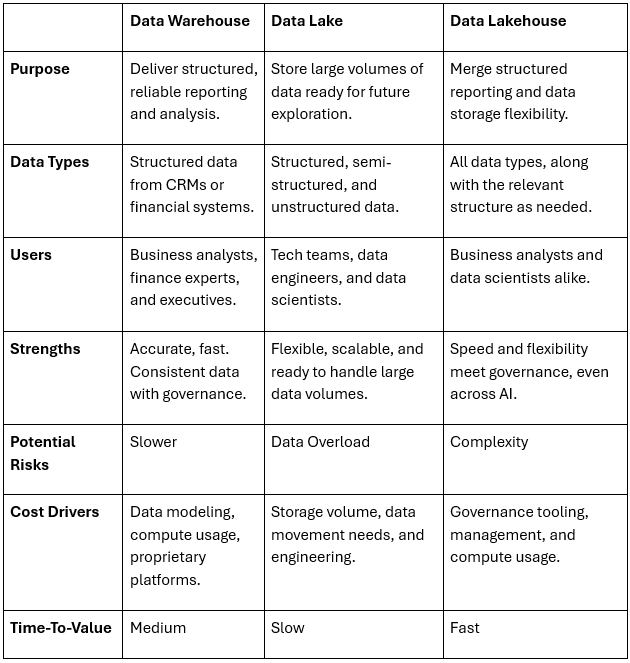
Data Warehouse, Data Lake, Data Lakehouse Comparison Table


Decision Framework


There is no single data storage solution that fits every organization. The right approach depends on business priorities, data complexity, and long-term objectives. The following considerations can help guide the evaluation of data warehouse, data lake, and data lakehouse options:


  • How mature are current data governance and ownership practices?
  • Which teams and roles require access to data?
  • How quickly must data be available for reporting or analysis?
  • How frequently are data requirements expected to change?
  • Is self-service reporting a priority across the organization?
  • Should the focus be on near-term reporting needs or long-term scalability?
  • How do current and projected budget constraints factor into the decision?


Common Pitfalls to Avoid


Boiling the ocean:  Attempting to ingest and model all available data at once often leads to delays, complexity, and limited early value.


Lack of business definitions:  Without clearly defined metrics and terminology, trust erodes as teams spend more time debating data than using it.


Ignoring data quality:  Poor data quality results in unreliable insights and undermines confidence in reporting and decision-making.

Underestimating ownership and governance:  Weak accountability and governance increase risk, particularly around security, compliance, and data misuse.


Selecting technology before defining use cases: When tools are chosen without clear business requirements, data environments become costly without delivering meaningful outcomes.


Recommended Approach for Most SMB and Mid-Market Organizations


While there is no universal answer when choosing between a data warehouse, data lake, or data lakehouse, most SMB and mid-market organizations benefit from starting with a warehouse-style, curated data layer. This approach provides a reliable foundation for core KPIs, standardized reporting, and consistent business definitions.


As data maturity increases, additional capabilities, such as data lake or lakehouse architectures, can be introduced to support unstructured data, advanced analytics, machine learning, or greater scale.


In most cases, the initial priority should be maximizing the value of structured data from financial systems, CRMs, and other core operational platforms. Establishing this foundation enables more confident decision-making, supports users across the organization (including non-technical teams), and creates a scalable path for future growth.


Get in Touch with Us!


Does your organization currently have a working data storage strategy? If not, reach out today to schedule a quick assessment and start the conversation.


Brewster Consulting Group is ready to help your business organize and optimize its data to support better reporting, analytics, and decision-making.


Contact us here!


Brewster Consulting Logo

At Brewster Consulting Group, we recognize that managing data can be a daunting task for small and mid-sized enterprises. Allow us to assist you in harnessing the potential of operational intelligence! Reach out to one of our specialists today to refine your data strategy, optimize your processes, and establish solid governance. Ready to cultivate data analysis and propel scalable growth? Your journey begins right here!

Book a meeting
By Ranae Peterson January 6, 2026
Overview: A recent client of ours, an energy company , partnered with Brewster Consulting Group and tasked our team with building a Well Data Mart for better management and review of their portfolio. The company operates hundreds of wells and PUDs; their data was scattered across multiple systems and reports, making it difficult to detect discrepancies and optimize financial performance. The Challenge: The company faced three major issues: -Fragmented Data Sources: Critical well-related data was housed in different systems, including OGSYS, ComboCurve, Monday.com, and others creating inconsistencies and blind spots. -Manual Processes: Reconciling information was time-consuming, error-prone, and often overlooked. -Hidden Financial Risk: Without a unified data view, invoices and payments tied to wells could slip through the cracks. With more than 400 wells in operation, even small errors could result in significant financial losses or missed opportunities. The Solution: Brewster Consulting Group designed and implemented a robust data mart, a centralized, subject-focused data repository, using: -SQL Server: A database platform that securely stores and organizes large volumes of data. -SSIS (SQL Server Integration Services): A tool that moves, transforms, and integrates data from multiple sources into the data mart. -Stored Procedures: Predefined sets of instructions that automate complex queries and calculations, making data analysis more consistent and reliable. -Database Views: Virtual tables whose contents are defined by a query, simplifying logic and table joins across the organization. Brewster worked closely with the client to build custom interest comparison views, a mechanism that compared ownership interest data in the Well Data Mart against multiple external sources. This allowed for precise cross-checking of well data and financial transactions. The Results: During analysis, Brewster’s system uncovered a $225,000 discrepancy tied to just two wells. The data mart revealed that two invoices had been paid incorrectly, and the company was owed that amount back. This example highlights the tangible financial benefits of centralized data management: - Financial Recovery: The company now can reclaim $225K. - Scalability: With over 400 wells to review, the potential for further savings is substantial. - Confidence in Data: Automated, reliable processes reduce human error and ensure decisions are backed by accurate insights. In addition to uncovering the $225K discrepancy, the biggest gains are noted below: Our client did not have a system of truth. Brewster worked closely with leadership to not only build the Well Data Mart, but to define primary systems of record and align business processes to ensure data is making its way into all systems. After making business decisions on primary systems of record, Brewster pulled data together from multiple, disparate systems into the Well Data Mart. They no longer have to spend hours or days writing queries to pull this data together. Brewster created numerous views for the company’s users. Though it is beneficial for them to have all of their data pulled together into the Data Mata, they needed recyclable queries for users to access . The guess work of joining tables together or having to write queries is gone. The views can be used as a data source in reports, and our client can easily apply filters as needed based on immediate reporting needs. Brewster is currently working on incorporating logging to display user adoption rates for the Well Data Mart. As shown with the invoice cost savings, the Well Data Mart can be used in conjunction with other data sets for comparison. Client Perspective: "We found that there were two wells that we were invoiced for, and we paid the invoices. We didn't actually elect into the wells, so there was miscommunication...we shouldn't have paid it. Now we're owed that money and that's $225,000 that would not have been caught if we did not have this data mart...and that's just scratching the surface. " -Director of Data Strategy & Optimization
By Ranae Peterson October 29, 2025
In the fast-paced world of marketing, agility is everything. But for many small marketing firms , staying organized and executing effectively can feel like an uphill battle. Between juggling client deliverables, managing creative teams, and keeping up with digital trends, it’s easy for even the most talented agencies to lose focus or momentum. That’s where fractional project management comes in - a cost-effective, flexible way for small agencies to gain project management expertise without the overhead of a full-time hire. What Is Fractional Project Management? Fractional project management allows marketing firms to hire an experienced project manager or project management team on a part-time, contract, or as-needed basis. These professionals provide the strategic direction, structure, and accountability of a full-time role, but with the flexibility and affordability that small firms need. Unlike traditional project management roles, fractional project managers adapt to your workflow. They can: Create or refine marketing project management frameworks. Oversee campaign timelines, deliverables, and communication. Manage resources, budgets, and vendor relationships. Introduce project management tools, such as Asana. Provide performance insights to keep campaigns aligned with business goals. The Common Challenges Small Marketing Firms Face: Running a small marketing firm means constantly balancing creativity, client satisfaction, and growth, all while working with limited time, budgets, and staff. While many small agencies deliver incredible results for their clients, their internal operations are often suboptimal. Without proper structure and project management in place, business operations can quickly become reactive instead of proactive. Here are some of the most common challenges small marketing firms face, many of which can be alleviated with the right fractional project management support: 1. Inconsistent Execution of Marketing Strategies Small firms often start projects with enthusiasm but struggle to maintain consistency across campaigns, clients, and platforms. Without a clear project roadmap or centralized process, teams can lose sight of timelines, priorities, or deliverables. This inconsistency can lead to missed deadlines, off-brand messaging, and a loss of client confidence over time. 2. Limited Budgets and Tight Margins Many boutique agencies operate on razor-thin margins, meaning that hiring a full-time senior project manager or operations manager may simply be out of reach. This leads to a “DIY” approach to project coordination, where creative directors, account managers, or even designers end up juggling scheduling and task tracking in addition to their core roles. It’s a recipe for burnout and inefficiency. 3. Attracting and Retaining Talent In the marketing world, top talent wants growth, clarity, and collaboration. When internal processes feel chaotic or constantly changing, employees can become frustrated or disengaged. A lack of structured project management can contribute to high turnover, especially among younger professionals looking for organized environments where they can learn and thrive. 4. Keeping Up with Industry Trends and Technology Marketing trends shift faster than ever, from SEO and social media algorithms to automation and analytics tools. Small firms, often focused on servicing clients, rarely have time to step back and strategically assess which technologies to adopt or how to integrate them effectively into their workflows. This can result in wasted subscriptions, underutilized tools, or outdated methods that slow productivity. 5. Balancing Growth and Quality As marketing firms grow, the complexity of managing multiple campaigns, channels, and clients multiplies. Without scalable project management processes, expansion can lead to growing pains: stretched teams, missed opportunities, and declining quality of work. Fractional project management can help maintain creative excellence while effectively scaling operations. 6. Cash Flow and Resource Allocation Project delays, scope creep, and unclear task ownership often lead to billing inaccuracies and wasted time. Many small agencies underestimate how much untracked work cuts into profit margins. Without proper project visibility or a defined workflow, forecasting becomes guesswork, making it harder to predict cash flow or plan for sustainable growth. 7. Client Communication and Expectation Management Misaligned expectations between the firm and its clients are another major pain point. When communication is informal or scattered across emails and chat threads, misunderstandings arise. A structured project management system creates transparency, accountability, and shared visibility, all key to stronger client relationships. 8. Content Creation Bottlenecks Small firms often pride themselves on creativity, but without workflow organization, content can get stuck in feedback loops. Campaign approvals, revisions, and scheduling can all become bottlenecks that stall production. Over time, this can limit the firm’s ability to scale output or deliver consistently across multiple accounts. 9. Lack of Technology Utilization Even when agencies have invested in tools like Asana, ClickUp, or Monday.com, they often fail to leverage them effectively. Either no one owns the system or team members don’t have time to update it. The result is a fragmented picture of project progress and duplicated effort, both of which fractional project managers specialize in resolving. 10. Burnout and Overwork With so many moving pieces, it’s no surprise that burnout is common among small marketing teams. When deadlines stack up and roles blur, people spend more time reacting to problems than delivering creative solutions. Over time, that stress impacts morale, retention, and ultimately, client results. In short: most small marketing firms aren’t lacking talent, they’re lacking structure. And without a scalable framework for managing people, projects, and priorities, even the most brilliant ideas can get lost in the shuffle. How Fractional Project Management Helps Small Marketing Firms Fractional project management offers both strategic and operational advantages for small agencies, including: Strategic Oversight Without the Cost: Fractional PMs bring senior-level strategy to the table without requiring a full-time salary. They guide teams on where to prioritize resources, how to align goals, and how to scale efficiently. Flexibility and Scalability: Whether your firm manages two clients or twenty, fractional project management services scale with you. You can engage in support during busy periods or for specific initiatives without long-term commitments. Immediate Access to Top Talent: Fractional project managers are seasoned professionals who’ve worked with multiple marketing firms, giving your team instant access to best practices and proven systems. Improved Accountability and Execution: With an external PM keeping projects on track, your creative team can focus on what they do best: creating and delivering exceptional marketing work. Enhanced Profitability and Efficiency: From budget management to workflow optimization, a fractional project manager helps uncover bottlenecks that waste time and money, improving cash flow and project margins. When Should a Small Marketing Firm Consider Fractional Project Management You might not need full-time help yet, but here are a few signs it’s time to bring in a fractional project manager : -You’re juggling too many high-value projects at once. -Projects are constantly behind schedule or over budget. -Your team is overworked, burned out, or missing deadlines. -You lack internal project management expertise. -You feel stuck or overwhelmed trying to manage growth. If these sound familiar, fractional project management might be the missing piece. The Bottom Line For small marketing firms, fractional project management isn’t just about organization; it’s about unlocking growth. With the right systems in place, marketing agencies can scale confidently, deliver better results, and focus on what they do best: creativity and strategy. As the marketing landscape evolves, fractional project management services offer a competitive edge, one that combines flexibility, structure, and cost efficiency.
By Ranae Peterson October 9, 2025
Many small businesses are laser-focused on growth, sales, and staying afloat. In that constant hustle, one of the most valuable assets, data , often gets overlooked. Even when businesses “look at the numbers,” that doesn’t always mean they’re collecting the right data, tracking the right KPIs, or translating those insights into actionable strategies. Fractional analytics bridges that gap. It allows small businesses to access experienced data analysts or analytics teams on a part-time or project basis, essentially bringing enterprise-level data expertise without the full-time cost. Think of it as analytics-as-a-service for small business owners who need clarity and insight but can’t justify a full analytics department. The Reality: Why Data Gets Overlooked While most business leaders know data is “important,” it can be hard to see its impact until it’s visualized through dashboards, real-time reporting, or guided by a professional who knows how to turn information into action. Without these tools and expertise, business decisions often rely on gut instinct instead of insight, leading to inefficiencies, missed opportunities, and in some cases, failure. Statistics show that: About 20% of small businesses don’t survive their first year. Nearly 50% fail within five years. Around 65% close within ten years. While the reasons vary, from financial mismanagement to poor planning, many of these challenges stem from a lack of data visibility or poor data management . In other words, the root cause often isn’t just financial; it’s analytical . Real World Analogy Imagine running a restaurant without ever checking what inventory levels, most frequent orders, or best margin products. You might think you’re doing well because the restaurant is busy, but when you do the books, you’re not actually making any money. Now, imagine having a fractional analytics consultant helping you organize and visualize your data. They don’t need to be in the kitchen every day, but when they are, they bring order to chaos, tracking inventory and margin by menu item, predicting staffing needs, and saving costs by cutting waste. That’s what fractional analytics does for your business data. It helps you understand what’s really happening across operations, finance, and customer service so you can make smarter, faster decisions. Common Operational Challenges Solved by Fractional Analytics Here are a few common pain points small businesses face that fractional analytics services can address: Inefficient reporting and manual data entry. Lack of clear KPIs or performance tracking. Inconsistent financial forecasting. Missed revenue opportunities due to incomplete data. Poor inventory or resource management. Lack of clarity around customer behavior and profitability. Benefits of Fractional Analytics for Small Businesses Engaging a fractional analytics provider offers far more than just numbers and dashboards. It’s about empowering smarter decisions without breaking the bank. Cost efficiency: Avoid the high salary and benefits of full-time analytics hire. Speed to impact: Gain immediate access to expertise, no lengthy onboarding or training required. Scalability: Bring in analytics support when you need it and scale it up as you grow. Better decision-making: Replace guesswork with data-driven insights and actionable KPIs. Time savings: Spend less time in spreadsheets and more time growing your business. Long-term cost reduction: Identify duplicate payments, missed invoices, and inefficiencies that quietly drain profit. Fractional analytics also enhances cash flow management and enables business leaders to spot opportunities for optimization, often resulting in measurable growth and sustainability. Why It’s a Make-or-Break Decision Choosing whether to work with a fractional analytics consultant could be the difference between surviving and thriving. Many business owners don’t realize that outsourced analytics is even an option, one that offers flexibility, affordability, and strategic insight without high overhead. The truth is, small business leaders don’t have to do it all alone, nor do they need to rush into hiring a full-time team. Fractional analytics gives them the best of both worlds: the expertise of a senior data strategist and the flexibility of a part-time engagement. Final Thoughts In today’s competitive market, data-driven decision making isn’t optional; it’s essential. Small businesses that embrace fractional analytics gain clarity, confidence, and control over their operations. By investing in the right insights today, they set up the foundation for sustainable growth tomorrow. If your business is ready to move from guessing to growing, now’s the time to explore what fractional analytics services can do for you.
Project Management Office Implementation
By Ranae Peterson September 3, 2025
This is a blog post detailing a case study where Brewster Consulting Group helped Allcare Health build a Project Management Office.
Process Optimization for Rental Cars
By Ranae Peterson September 3, 2025
This case study covers process improvement consulting for a rental car company.
Process Optimization for Healthcare
By Ranae Peterson September 3, 2025
This case study covers process optimization and improvement for a healthcare company
Consumer Goods Analytics
By Ranae Peterson September 3, 2025
This case study covers developing Power BI dashboards and power bi reports for a consumer goods company.
Health and Safety Power BI Dashboard
By Ranae Peterson September 3, 2025
This case study covers creating a Health and Safety dashboard in Power BI for DP World.
Power BI Financial Dashboard
By Ranae Peterson September 3, 2025
This case study covers building a financial dashboard in Power BI for Medefy
Power BI Dashboard Development
By Ranae Peterson September 3, 2025
This case study covers building an operational dashboard in Power BI for Tulsa International Airport